


By: Trokon Wrepue – trokon1992eokin@gmail.com
BERLIN – In a historic step toward addressing the growing impact of climate change on human mobility, Liberia has launched its first-ever effort to develop a National Climate Mobility Strategy.
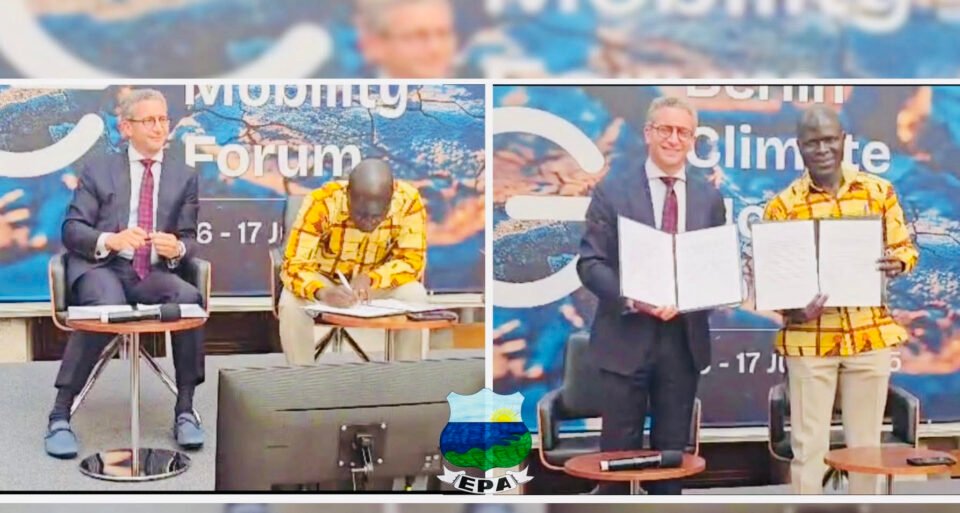
This landmark initiative was formalized on June 17, 2025, when Dr. Emmanuel King Urey Yarkpawolo, Executive Director and CEO of the Environmental Protection Agency (EPA) of Liberia, signed an agreement at the Berlin Climate Mobility Forum.
This pivotal agreement empowers the EPA to carry out a Climate Mobility Assessment, a nationwide study designed to investigate how climate change is displacing people and how national policies can better respond.
The signing took place during a high-level session of the Berlin forum, attended by international climate leaders, policymakers, and civil society organizations.
“Climate change is no longer a distant threat—it is a current reality that is reshaping lives and livelihoods,” said Dr. Urey Yarkpawolo.
“Through this agreement, we are committing to assess the scale and nature of climate-induced mobility and to craft a national strategy that safeguards vulnerable communities while ensuring sustainable development.”
Key Areas of the Climate Mobility Assessment include collecting data on at-risk populations and regions vulnerable to climate impacts, engaging communities and stakeholders through national and local consultations, mapping movement patterns tied to environmental change and Incorporating mobility data into disaster preparedness and development planning.
The findings will directly inform the development of Liberia’s National Climate Mobility Strategy, a long-term framework to protect climate-displaced individuals and ensure no one is left behind during climate transitions.
Held under the theme “Pathways to Protection: Addressing Climate Mobility through Policy and Practice,” the Berlin Climate Mobility Forum provided Liberia a platform to amplify its voice and seek international collaboration.
Dr. Urey Yarkpawolo emphasized that this effort is not only a policy breakthrough but a people-centered initiativefocused onclimate justice.
“This is the first time in Liberia’s history that a focused, data-driven initiative will be undertaken to understand and address climate-induced migration,” he stated. “It is not just a policy move—it is a people-first strategy to ensure that climate justice reaches every corner of the country.”
Liberia’s proactive approach aligns with its commitments under the Paris Agreement and underscores its leadership in preparing for the human dimensions of climate change—before disaster strikes.
As climate pressures intensify across West Africa, Liberia’s pioneering move marks a bold and hopeful step toward protecting lives, livelihoods, and the environment through science-based, inclusive policymaking.
