


By: Trokon Wrepue – trokon1992seokin@gmail.com
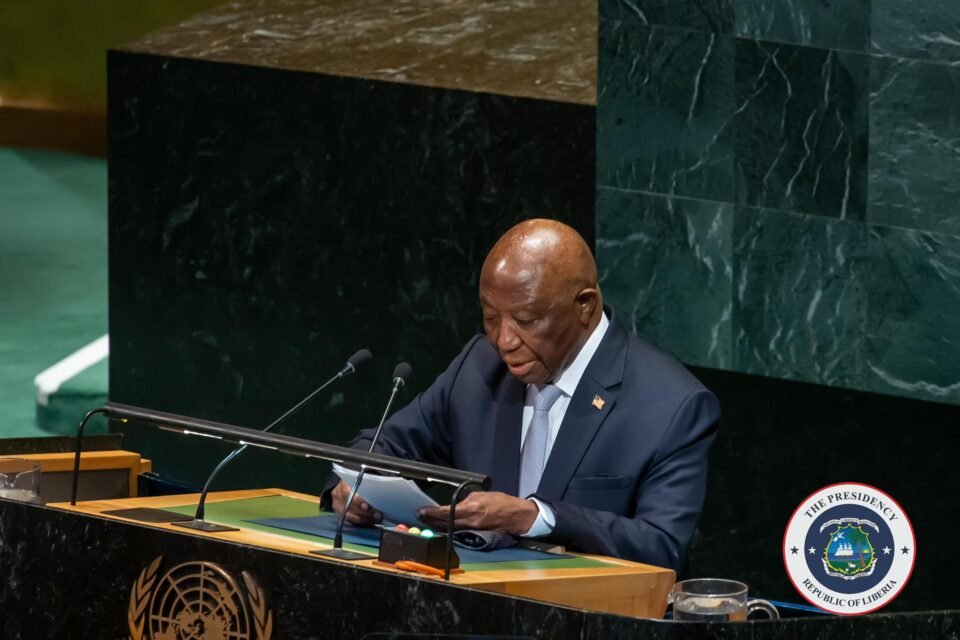
New York – President Joseph Boakai shocked diplomats and unsettled political allies on Tuesday with a fiery speech at the 80th United National General Assembly, where he openly challenged the global order, demanded the creation of a war and economic crimes court back home and positioned Liberia at the center of highly divisive international disputes.
The 80-year-old leader, known for his soft-spoken style at home, adopted a strikingly confrontational tone on the world stage, blasting the international financial system as “unjust,” calling for “climate justice” that forces rich nations to pay more and daring to frame Liberia’s temporary seat on the UN Security Council as a continental mandate, rather than a national one.
“While the nameplate during this two-year term will read Liberia, the seat belongs to Africa,” Boakai declared, a remark some African delegations quietly applauded but others dismissed as naïve posturing from a nation still dependent on aid and peacekeeping legacies.
War Crimes Court Bombshell
The loudest controversy erupted when Boakai renewed Liberia’s request for a War and Economic Crimes Court – a demand that instantly reignited a debate back home.
“We renew our government’s request for international support in establishing a War and Economic Crimes Court,” he told the Assembly.
While victims’ groups have welcomed the pronouncement, it will draw furious condemnation from political figures tied to Liberia’s bloody past, some of whom sit in privileged positions and still command grassroots loyalty.
Critics say Boakai’s push risks destabilizing Liberia’s fragile peace and could be a political time bomb that divides the nation rather than heals it.
Foreign Policy Firestorm
On the global conflicts, Boakai openly endorsed the two-state solution for Israel and Palestine, aligning Liberia with the African Union’s stance but potentially clashing with Washington, Monrovia’s closet ally.
The Liberian leader voiced support for mediation in the Russia-Ukraine war, a position seen by some as sitting on the fence at a time when the West demands clear condemnation of Moscow.
Diplomats muttered afterward that Liberia had “overreached” and could find itself isolated for stepping into battles far bigger than its weight class.
Challenging the Global North
Mr. Boakai’s fiercest words targeted the international financial system which he blasted as outdated and rigged against the global south.
He accused rich nations of trapping poorer countire in debt while failing to meet climate commitments.
“Too many developing nations spend more on debt servicing than on health or education,” Boakai thundered, joining a chorus of Global South leaders demanding radical reforms.
But critics warn that such rhetoric could backfire, jeopardizing Liberia’s access to desperately needed western loans, grants and investments.
The ARREST Agenda or Empty Rhetoric?
Domestically, Boakai touted his ARREST Agenda—a sweeping plan to boost agriculture, roads, governance, education, health, and tourism.
Yet, opposition figures at home quickly dismissed the speech as “empty rhetoric abroad while Liberians suffer at home.”
They argue that corruption, food insecurity, and joblessness remain unaddressed while the president appears more interested in courting global headlines than fixing bread-and-butter issues.
A Risky Gamble for Liberia
To his supporters, Boakai’s speech was a bold declaration that Liberia will no longer be a silent spectator in global affairs. To his critics, it was reckless, confrontational, and dangerous for a small, fragile country still struggling to regain its economic footing.
By confronting the West on finance, siding with Africa on Security Council reform, and pushing for a war crimes court that could ensnare powerful figures at home, Boakai may have set Liberia on a collision course with both domestic power brokers and key international allies.
The question now is whether this bold gamble will elevate Liberia’s global standing—or plunge the nation into fresh turmoil.
