


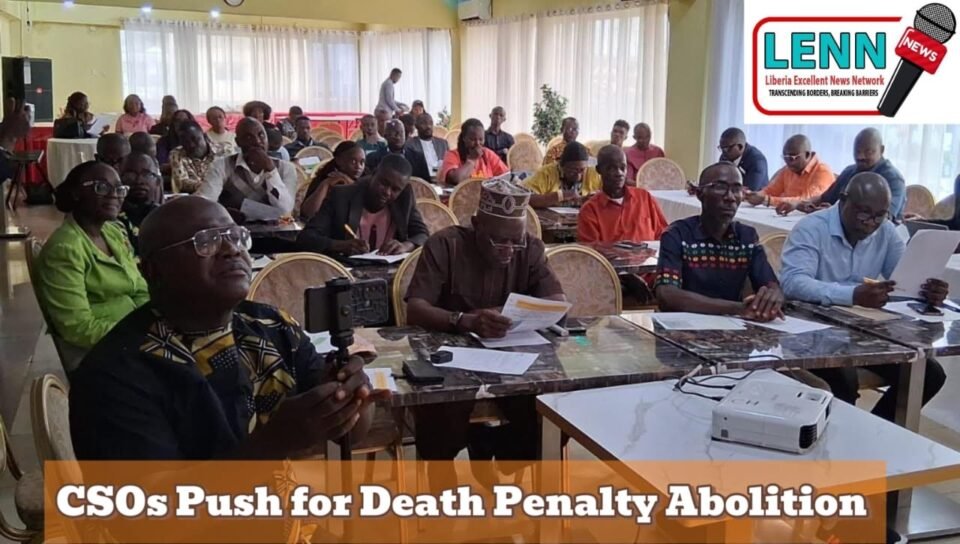
A cross-section of civil society actors at the launch of the project
By: Marka B. Davis
Monrovia, Liberia – The Civil Society Human Rights Advocacy Platform of Liberia has launched the second phase of its advocacy project to abolish the death penalty in Liberia.
The $84,650 project titled: Abolition of Death Penalty in Liberia, is funded by the British Embassy near Monrovia through the Magna Carta Fund, and is being implemented by the Civil Society Human Rights Advocacy Platform of Liberia (CSO Platform).
Speaking at the official launch Wednesday in Monrovia, Adama Dempster, Secretary-General of the CSO Platform, highlighted the history and urgency of the campaign.
“Liberia acceded to the Second Optional Protocol to the International Covenant on Civil and Political Rights (ICCPR) in 2005, committing to abolish the death penalty. While a moratorium on executions was imposed, the death penalty was reintroduced between 2005 and 2008 in response to rising armed robbery, hijacking, and terrorism. Today, about 14 individuals remain on death row,” Dempster said.
He explained that the five-month project, running from October 2025 to March 2026, seeks to promote human rights and the rule of law by engaging civil society organizations across the country to advocate for the abolition of capital punishment.
“Liberia is already making progress, but the global movement against the death penalty has gained significant momentum, with 144 countries—including 23 in Africa—abolishing it in law and practice. The United Nations and human rights bodies emphasize that capital punishment is incompatible with human dignity,” Dempster noted.
He added that civil society has submitted a 10-page shadow report to the UN Human Rights Council as part of Liberia’s Universal Periodic Review (UPR), with the country’s review scheduled for November 3–7, 2025, in Geneva. He called on the government, as a non-permanent member of the UN Security Council, to abolish the death penalty and commute all death sentences to life imprisonment.
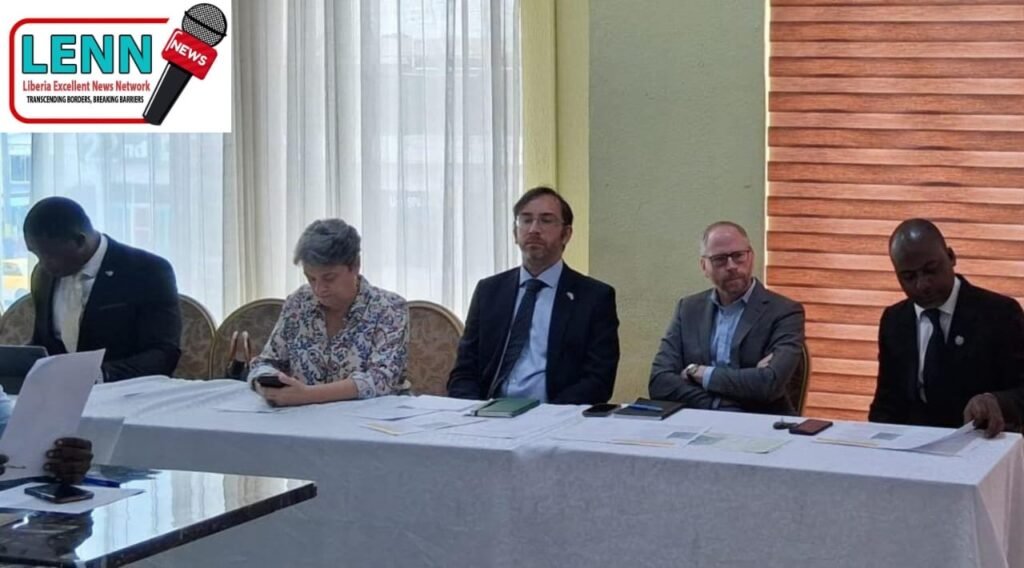
Partners attending the project launch, including UK Chargé d’Affaires, Simon Tooth (middle)
The launch also featured remarks from the British Embassy, which praised the CSO Platform for its dedication and coordination among civil society and international partners.
The Embassy reaffirmed the UK’s opposition to the death penalty under all circumstances, citing its incompatibility with human dignity, lack of proven deterrent value, and the irreversible consequences in cases of miscarriage of justice.
Chargé d’Affaires Simon Tooth said the draft bill to abolish the death penalty in Liberia has made significant progress but emphasized that more work remains.
“We urge all partners—including the government, judiciary, legislature, religious groups, civil society, and media—to continue working together to pass this bill and remove capital punishment from Liberia’s penal code,” Tooth said.
He further stressed the importance of education and advocacy, noting that the project will continue raising awareness about human rights implications and alternative justice measures.
He concluded with a call for unity:
“Where there are challenges, let us look for solutions. Where there are differences, let us find compromises. And where there are barriers, let us strive for progress. Together, we can make this project a success and move Liberia closer to joining the growing number of abolitionist countries worldwide.”
