


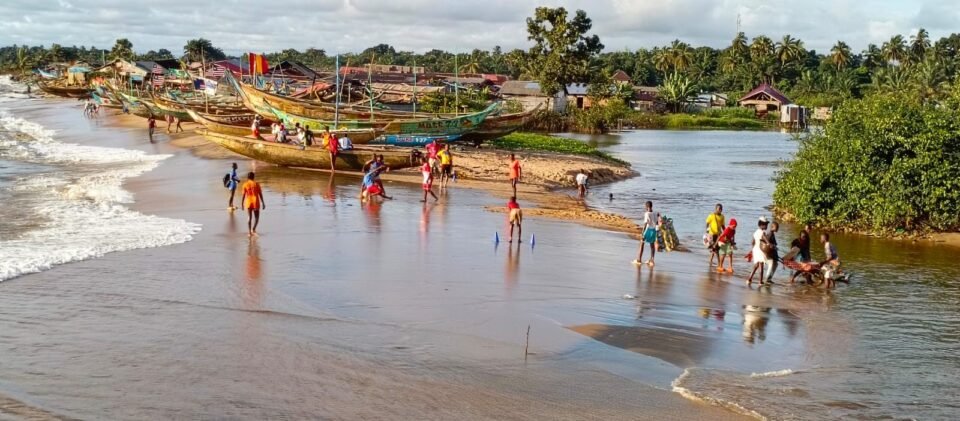
What used to be a children play ground in Balawles, Buchanan, taken over by the sea
NATIONAL NEWS
MONROVIA – A coalition of leading climate and environmental rights organizations has sharply criticized the Government of Liberia for voting against a landmark United Nations General Assembly resolution supporting the International Court of Justice (ICJ) advisory opinion on climate change.
By: Trokon S. Wrepue – trokon1992seokin@gmail.com
The groups described Liberia’s decision as a major contradiction of the country’s own climate commitments and a move that risks undermining Africa’s collective push for climate justice and international accountability.
In a joint statement issued Friday, Green Advocates International (GAI), the Alliance for Rural Democracy (ARD), and the Natural Resource Women Platform (NRWP) said they were “deeply disappointed and concerned” that Liberia joined a small group of countries opposing the resolution overwhelmingly backed by 141 UN member states.
Countries that voted against the measure included the United States, Russia, Saudi Arabia, Iran, Israel, Belarus, Yemen, and Liberia — the only African nation to oppose the resolution.
The resolution seeks to strengthen international legal obligations on climate action, accountability, and the protection of vulnerable countries suffering the devastating effects of climate change.
Alfred Lahai Gbabai Brownell Sr., Founder of Green Advocates International and recipient of the 2019 Goldman Environmental Prize, described Liberia’s vote as troubling and diplomatically isolating.
“It is unfortunate that Liberia, which currently holds a seat on the United Nations Security Council representing Africa, chose to isolate itself from the rest of the African continent by becoming the only African country to vote against the resolution,” Brownell said.
The consortium argued that Liberia’s opposition directly contradicts repeated appeals by the government for climate reparations, climate financing, green investments, and international support for climate-related loss and damage.
The groups referenced a 2024 World Bank Country Climate and Development Report which ranks Liberia among the countries most vulnerable to climate change impacts.
According to the report, climate threats continue to endanger Liberia’s coastal infrastructure, food systems, public health, and economy, warning that without effective adaptation measures, climate change could shrink Liberia’s economy by up to 15 percent and push nearly 1.3 million people into extreme poverty by 2050.
The statement further noted that Liberia has already committed under the Paris Agreement and its Nationally Determined Contributions (NDCs) to reduce greenhouse gas emissions by 64 percent below business-as-usual levels by 2030, with support from international climate financing and technology transfer.
ARD Head of Secretariat, Windor B. Smith, reminded the government of its promises to protect the Upper Guinean rainforest, reduce deforestation, and strengthen climate resilience through community-led conservation initiatives.
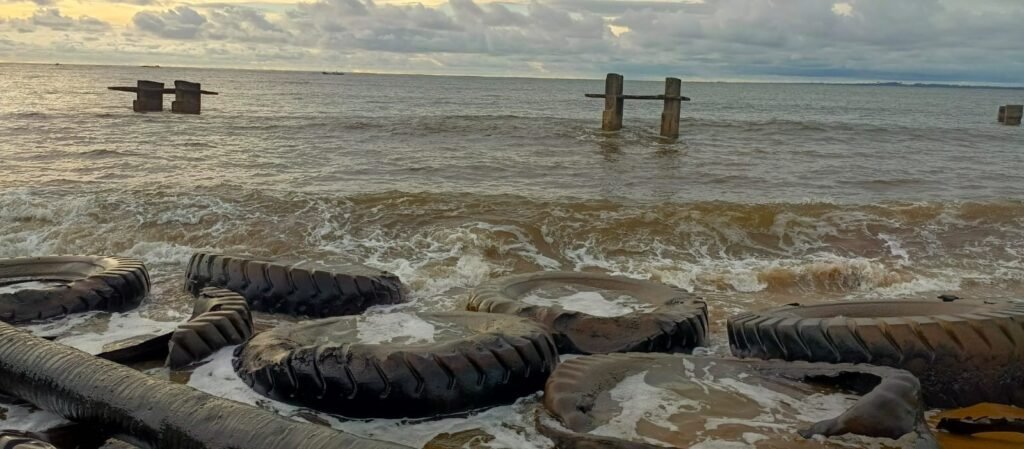
A failed improvised effort at coastal defense in Big Fanti, Buchanan
Meanwhile, Green Advocates Staff Lawyer and African Climate Platform focal person, Atty. AL Varney Rogers, warned that the vote could damage Liberia’s standing in future international climate negotiations.
“The vote risks undermining Liberia’s credibility in international climate negotiations and weakening Africa’s collective voice on climate justice,” Rogers cautioned.
The organizations also highlighted growing environmental and public health threats facing Liberia, including severe flooding, coastal erosion, water contamination, rising temperatures, and increasing disease outbreaks.
Radiatu Sherif-Kahnplaye of the Natural Resource Women Platform questioned how Liberia could seek global climate solidarity while opposing an initiative designed to strengthen climate accountability worldwide.
“How can a climate-vulnerable nation demand international solidarity and financial support for climate resilience while simultaneously voting against a resolution aimed at strengthening global accountability and climate justice?” she asked.
The coalition pointed to the worsening realities in vulnerable coastal communities, particularly in Buchanan, Grand Bassa County, where residents continue to battle severe coastal erosion and flooding.
GAI Acting Executive Director Francis K. Colee said entire community spaces, including children’s football grounds and major roads, have already been swallowed by the sea.
The environmental groups are now calling on the Liberian government to publicly explain the rationale behind its vote against the UN climate justice resolution, insisting that Liberia must stand with vulnerable nations and affected communities in the global fight against climate change.
