


NATIONAL NEWS
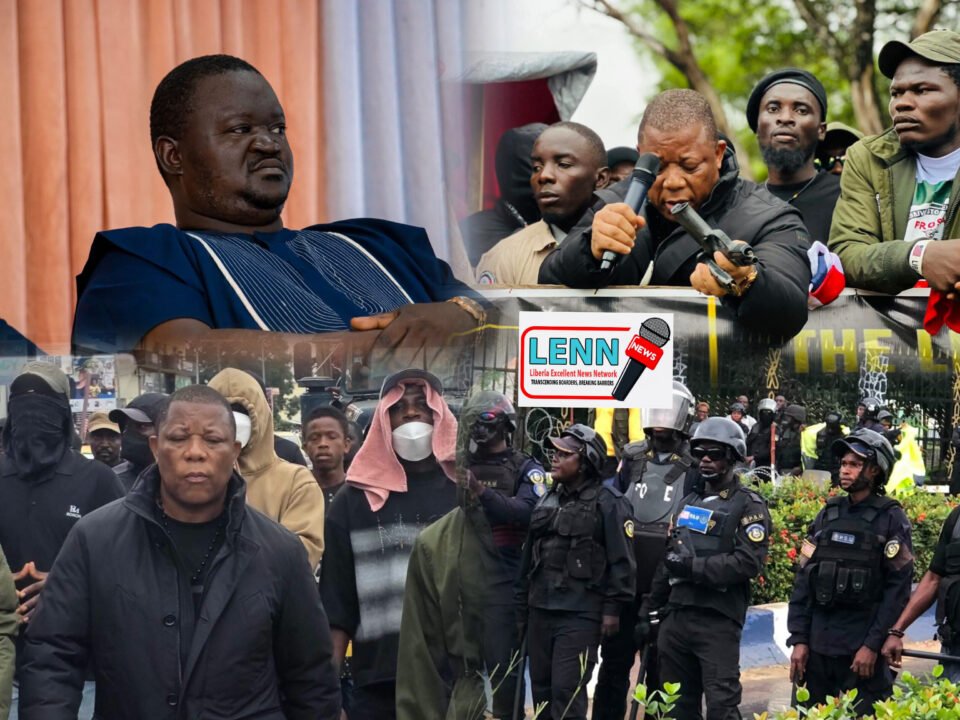
MONROVIA – Samuka V. Konneh, Project Director of Internews, has questioned the decision by protest organizers to disarm a law enforcement officer during Thursday’s “Lead or Leave” demonstration in Monrovia, warning that the incident could have legal consequences while urging the Solidarity and Trust for a New Day (STAND) movement to reconsider its approach to civic activism.
By: Trokon S. Wrepue – trokon1992seokin@gmail.com
In a lengthy Facebook post following the protest, Mr Konneh argued that it is not unusual for law enforcement officers to carry firearms while providing security at public demonstrations, stressing that the critical issue is whether the weapon is used appropriately.
“In all fairness, you don’t expect a law enforcement officer to attend a protest rally without a weapon. To use it and not to use is situational. But from all indications today, it wasn’t used. So, why did you disarm a law enforcement officer? And if you disarmed a law enforcement officer, why are you keeping the weapon up till now?” he wrote.
His comments come amid heightened political tensions following the July 17 “Lead or Leave” protest organized by STAND, led by Mulbah K. Morlu Jr.
The demonstration attracted hundreds of participants and was heavily monitored by officers of the Liberia National Police (LNP).
Following the protest, police announced that they had declared Mr Morlu “armed and dangerous,” alleging that he displayed a firearm during the event. STAND, however, has maintained that the firearm was taken from a police officer during the protest.
Addressing that claim, Mr Konneh suggested the incident could expose organizers to legal scrutiny regardless of which version of events is ultimately established.
“This could be a double jeopardy for the protest organizers, I guess. If you admit that you disarmed a law enforcement officer, you’ve probably committed a crime. If it also happened that you lied and the carrier wasn’t a law enforcement officer, then you have to identify and produce the person you disarmed. Either way, that chapter of the play won’t go well.”
Mr Konneh further noted that the Liberia National Police has reportedly claimed ownership of the firearm allegedly seized during the protest and has demanded its return.
“Now, the Liberia National Police – LNP says the weapon you seized from the officer belongs to them. They want it. You have to turn it over. I am just imagining how many different fingerprints would be on that weapon at this hour?”
Beyond the controversy surrounding the firearm, the Internews Project Director raised broader concerns about STAND’s role in Liberia’s democratic landscape, questioning whether the organization continues to operate as a civil society organization or has evolved into a political movement.
“On a serious note, at some point, Mulbah K. Morlu Jr. and his STAND organization will have to truly decide if they’re a civil society organization or a political pressure group; a civil society organization or an opposition party; a civil society organization or a political action committee.”
According to him, organizations that identify themselves as civil society groups carry unique responsibilities that distinguish them from political actors.
“There is a very good reason why certain organizations are called ‘civil society organizations. They’re not just any organizations outside of government.”
Mr Konneh argued that while governments have a responsibility to protect democratic freedoms, civil society organizations should place greater emphasis on dialogue and civic engagement before resorting to public demonstrations.
“While we demand and insist that the government creates, maintains and protects a safe space for democracy and governance, groups identifying themselves as civil society must explore ways for civic engagements – first and foremost. Protests should only be a last resort/result.”
He warned that demonstrations, although constitutionally protected, carry an inherent risk of violence and can sometimes undermine opportunities for constructive dialogue.
“There is really no guarantee that a protest will end civil. There is always a chance of violence, for which care must be taken by all sides. Protests also erode chances of civic engagements and mutually beneficial settlement of disagreement.”
Reflecting on STAND’s history of activism, Mr Konneh said the organization appears to rely predominantly on protest rallies, arguing that such an approach may be limiting its effectiveness.
“From what I’ve personally documented, all engagements by STAND have been protest rallies; and a profile like that creates buffer even if your intentions are good.”
He also questioned whether the movement’s demonstrations have achieved significant results, suggesting that the organization should reassess both its methods and messaging.
“I’ve not seen that level of momentum and results from protests organized by STAND and Mr. Morlu. Maybe it’s time to recalibrate not just on how to engage government, but more so what issues to talk to people about and what faces to use that would move them to join your protest.”
Mr Konneh argued that successful public demonstrations depend not only on dissatisfaction with government but also on the relevance of the issues being raised and the credibility of those leading the campaign.
“The issues, theme, faces and goal of a protest are what build momentum and push people to action. All of these have to be in the package to move people, not just their collective opposition.”
Using himself as an example, he said he would readily participate in demonstrations centered on broader national concerns rather than partisan politics.
“Many people join protest who have nothing to do with politics, but have strong convictions on the issues being protested. For example, me. I have no serious political interests but would gladly join a protest against drugs, SGBV, land grab, and protests to fund mental health, freedom and access to information, etc. But despite my willingness to join such protests, I would also check on the faces and voices leading the protest.”
His remarks add another perspective to the growing national debate over the conduct of Thursday’s protest, the seizure of the firearm, and the future direction of civic activism in Liberia. As investigations continue and both STAND and the Liberia National Police maintain their respective positions, the controversy is expected to remain at the centre of public and political discussion in the days ahead.
