


NATIONAL NEWS
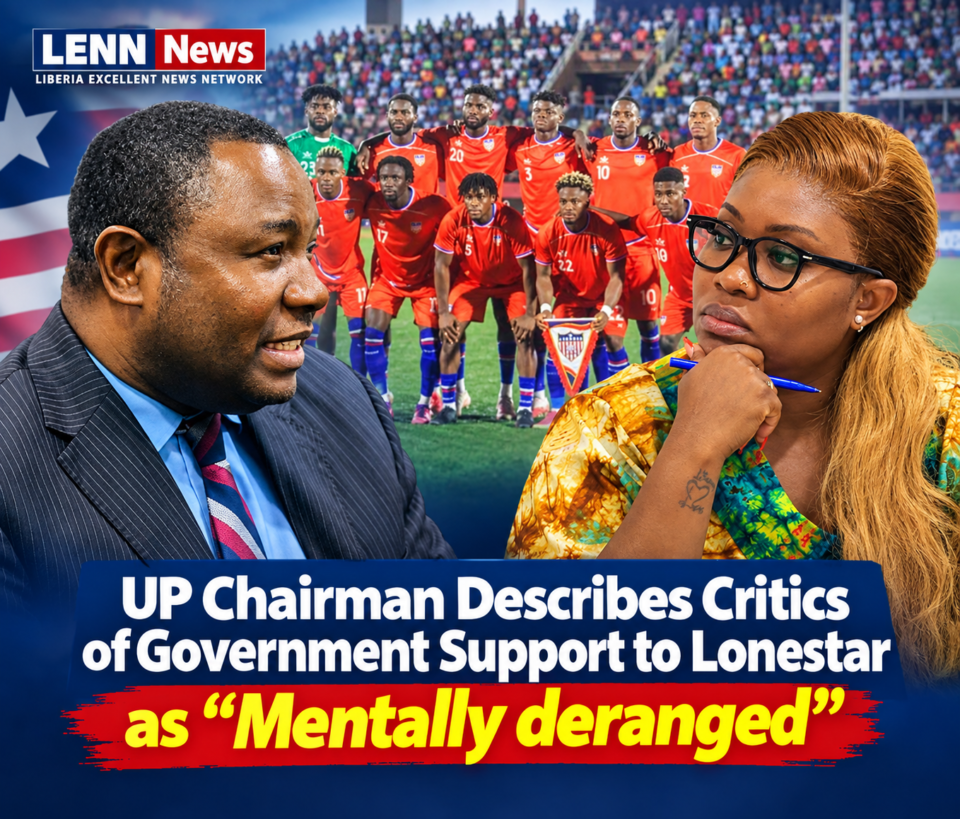
MONROVIA – A bitter political controversy has erupted around Liberia’s national football team after Unity Party Chairman Rev. Luther Tarpeh branded critics within the opposition Coalition for Democratic Change as “mentally deranged,” accused them of having a “detestable reasoning capacity,” and described them as “crab mentality CDcians” in a fiery social media post following the Lone Star’s latest defeat.
By: Trokon S. Wrepue – trokon1992seokin@gmail.com
Tarpeh, who also chairs the National Mobilization Committee for the Lone Star, initially thanked Liberians for what he called an “amazing” turnout and urged supporters not to lose hope after the team’s disappointing results.
But the Unity Party chairman quickly turned his message into a political broadside against CDC supporters who questioned why the government was being asked to intervene in longstanding problems confronting the national team.
He questioned whether the critics remained bitter over the CDC’s removal from power in the 2023 elections and suggested their political defeat had left them “mentally deranged” and unable to distinguish between partisan politics and patriotic service.
The most explosive part of Tarpeh’s statement came when he said that, were it not for “very good few friends” within the CDC, he would launch a campaign to “donate these people called CDcians somewhere else” so they could “leave our country alone.”
He further accused the opposition supporters of having “unpatriotic characteristics” and a “toxic outlook” toward anything that could raise Liberia’s national and international profile.
Tarpeh also defended the government’s decision to address the Lone Star’s problems, pointing to his own intervention after visiting the team in Morocco and saying the concerns he encountered were subsequently elevated to the National Legislature and Executive Branch.
But Tarpeh’s political attack has now produced an unusual public rebuke from within the government itself. Youth and Sports Minister Atty. Cornelia Wonkerleh Kruah has openly rejected the statement, distancing her ministry from the position taken by the chairman of the committee responsible for mobilizing national support for Liberia’s football team.
Atty. Kruah said she intends to have a conversation with Tarpeh, but insisted on publicly expressing her disagreement because his comments had already been made public.
Kruah stressed that the role of National Team Mobilization Chair is not supposed to be divisive, but should serve as a bridge between politicians, government institutions and the wider population that supports the Lone Star.
Her intervention places the controversy beyond a simple Tarpeh-versus-CDC confrontation and raises questions about whether a national football platform can effectively unite Liberians when its leading mobilizer is simultaneously using it to wage a political battle.
Recent coverage of the controversy has similarly highlighted concerns over the blending of party politics and the national team.
The confrontation has therefore exposed an uncomfortable contradiction at the heart of Liberia’s football mobilization drive: Tarpeh says his intervention is motivated by patriotism and a desire to build a competitive national team, while his public language has drawn criticism for appearing to divide the very constituency he is expected to mobilize.
With the Lone Star seeking broader national support, the question now dominating the debate is whether Liberia’s football revival can be separated from the increasingly heated political rivalry between the Unity Party and the CDC.
