


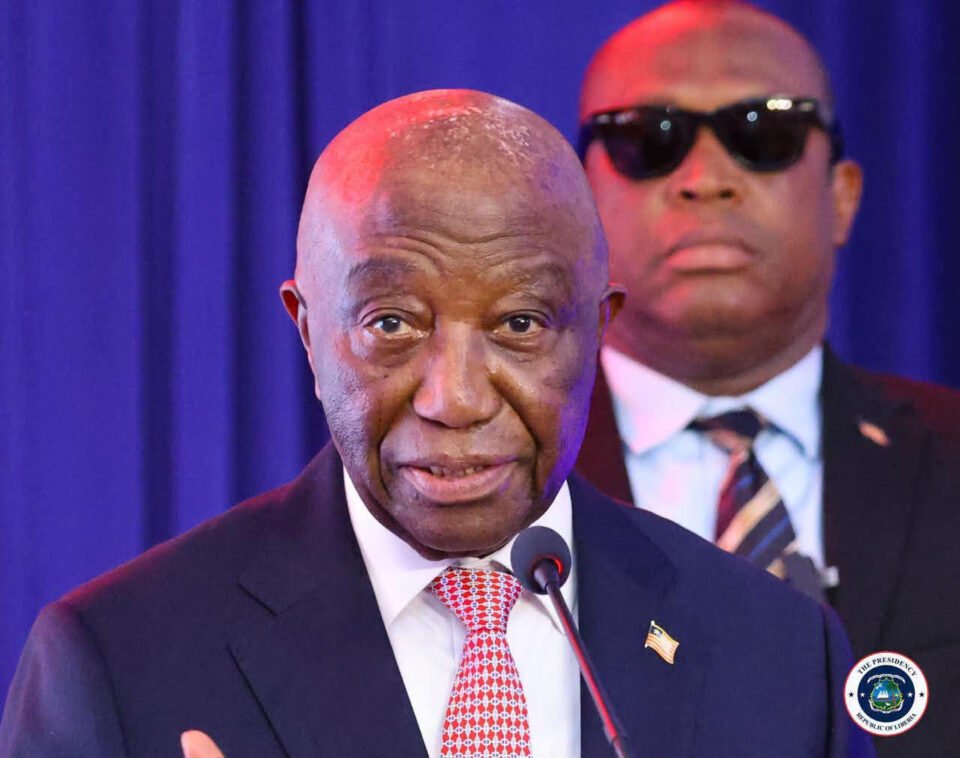
Margibi County – President Joseph Nyuma Boakai has announced a series of major mining and energy reforms, including plans to establish a national mining company, create a sovereign wealth fund, construct Liberia’s first gold processing facility within two years, and increase renewable energy to 75 percent of the country’s electricity generation mix.
By: Trokon S. Wrepue – trokon1992seokin@gmail.com
Speaking Wednesday at the opening of the Liberia International Mining and Energy Conference and Expo (LIMEC 2026) at the Farmington Hotel in Harbel, Margibi County, President Boakai said Liberia must move beyond exporting raw minerals and instead use its natural resources to drive industrial development, create jobs, expand electricity access, and build long-term national wealth.
The President said his administration intends to transform the mining and energy sectors into stronger drivers of economic growth under the government’s ARREST Agenda for Inclusive Development, emphasizing that natural resource wealth must translate into tangible benefits for Liberian citizens.
“Natural resources alone do not guarantee transformation,” President Boakai said, stressing the need for responsible investment, reliable infrastructure, affordable electricity, effective institutions, and consistently enforced laws.
He called on international investors, mining executives, energy developers, financiers, and technical experts to partner with Liberia in developing its mineral resources and expanding energy infrastructure, while respecting environmental standards and the interests of communities hosting major projects.
Government Targets Greater National Ownership of Mineral Wealth
One of the most significant announcements was the planned establishment of the National Mining Company of Liberia, which President Boakai said would enable the state to participate more actively in the mining industry through equity and strategic ownership.
The initiative is intended to move Liberia beyond a model that relies primarily on collecting royalties and taxes from mining companies, allowing the government to pursue a more direct role in generating returns from the country’s mineral resources.
The President said Liberia possesses substantial deposits of iron ore, gold, diamonds, critical minerals, and rare earth elements, but the country must strengthen its ability to capture greater economic value from these resources.
He noted that iron ore remains a major contributor to the economy, while gold, diamonds, and other emerging mineral opportunities offer prospects for diversifying the sector and attracting additional investment.
President Boakai maintained that the government’s priority is to attract responsible investors while improving mineral governance, geological information, domestic participation, and the economic returns generated for the country.
He also stressed that mining companies must comply with national laws, pay required taxes and fees, meet environmental obligations, and respect workers and communities affected by their operations.
Liberia Plans First Gold Processing Facility Within Two Years
President Boakai announced that the government intends to establish Liberia’s first gold processing facility within the next two years as part of a broader strategy to promote domestic mineral processing and value addition.
Under the proposed policy, gold extracted in Liberia would undergo primary and secondary refining at licensed domestic facilities to internationally recognized purity standards before export.
The President said the initiative aligns with the African Minerals Strategy Group’s call for African countries to retain more value from their natural resources instead of exporting unprocessed commodities.
For Liberia, the proposed facility could create opportunities for skilled employment, technical training, investment in supporting industries, and greater domestic participation in the gold value chain.
Boakai argued that resource-rich countries have historically lost significant economic opportunities by exporting raw materials while importing finished products, technology, and expertise.
He said Liberia intends to pursue a different development path by connecting mineral extraction with processing, manufacturing, infrastructure development, and employment creation.
The proposed gold processing facility is therefore expected to form part of the government’s broader effort to strengthen domestic industries and increase the economic benefits derived from mineral production.
However, the project’s implementation will depend on the development of the necessary facilities, investment arrangements, regulatory systems, and technical capacity.
Sovereign Wealth Fund to Preserve Mineral Revenues for Future Generations
The President also announced authorization for the creation of the Liberia Sovereign Wealth Fund, which he said is intended to operate as an independent investment vehicle in accordance with the internationally recognized Santiago Principles.
The proposed fund would receive a fixed percentage of mineral revenues for investment in diversified domestic and international assets, helping convert proceeds from exhaustible natural resources into long-term financial wealth.
According to Boakai, the initiative would help Liberia protect part of its resource income against commodity-market fluctuations while building financial security for future generations.
The proposed fund represents another element of the government’s plan to improve the management of mineral revenues and ensure that income generated from mining contributes to sustainable national development.
Liberia’s dependence on commodity exports makes revenue management particularly important because fluctuations in international prices can affect government income, foreign exchange earnings, investment, and broader economic performance.
The President’s announcement signals an intention to strengthen long-term financial planning around the country’s mineral resources.
Further details concerning the fund’s operational structure, governance arrangements, investment framework, and implementation timeline were not provided in the address.
Mining Contributes 18.4% of GDP as Government Reports Revenue Growth
President Boakai said mining remains one of the principal pillars of Liberia’s economy, supporting exports, foreign exchange earnings, public revenue, employment, infrastructure, and economic activity in mining communities.
According to figures presented in his address, the mining sector expanded by 17 percent since January 2024.
He said Liberia recorded overall economic growth of 5.1 percent, with real GDP growth of 5.5 percent projected, while mining accounted for 18.4 percent of real GDP in 2025. The sector’s contribution is projected to rise to 19.4 percent in 2026.
The President further stated that mining contributed approximately US$124 million directly to national revenue in 2024 and that the sector had contributed US$432 million to domestic revenue to date.
He linked the country’s broader revenue performance to the government’s projection of US$1.1 billion in domestic revenue for 2026, compared with US$699 million in 2024.
Boakai said stronger domestic revenue collection would support government spending on infrastructure, education, healthcare, and other national development priorities.
He nevertheless emphasized that increased production and revenue collection must be accompanied by reforms that improve transparency, strengthen institutional capacity, and ensure communities benefit more directly from mineral development.
US$30 Million Geological Survey Planned Under MCC Compact
To improve knowledge of Liberia’s mineral potential and attract additional investment, President Boakai announced plans for a US$30 million airborne geophysical data collection program under the Millennium Challenge Corporation (MCC) compact.
The program is expected to support systematic geological exploration and improve information about critical and strategic minerals across the country.
The President said reliable geological data is essential to helping investors assess mineral deposits, identify exploration priorities, evaluate project risks, and make informed investment decisions.
He added that the government is advancing a coordinated national exploration program over the next five years, including geological mapping, analysis of new findings, improved mineral information management, and broader access to technical data.
The government also intends to improve transparency in the administration of mineral rights by strengthening licensing procedures, making official fee schedules more accessible, and expanding digital licensing and mineral information systems.
Boakai said the Minerals and Mining Law and related regulations would be reviewed to reflect evolving investment practices, environmental standards, technological developments, and Liberia’s national development objectives.
He stressed that predictable regulations and fair administration are necessary to attract credible investors while protecting the country’s interests.
The proposed reforms are also intended to strengthen oversight of license holders and improve accountability throughout the mining sector.
Boakai Targets 75% Renewable Electricity Generation
Turning to the energy sector, President Boakai said unreliable, expensive, and limited electricity continues to constrain businesses, raise production costs, discourage investment, and restrict access to essential services.
He said electricity must become a foundation for industrial growth, agricultural processing, manufacturing, small businesses, hospitals, schools, and household development.
The government, he explained, is pursuing a combination of renewable energy generation, stronger transmission and distribution networks, regional electricity integration, improved utility performance, and greater private-sector participation.
Boakai announced that Liberia’s national ambition is to increase renewable energy to 75 percent of the electricity generation mix while expanding access and improving the reliability of supply.
As part of this effort, he highlighted the 20-megawatt solar photovoltaic facility associated with the Mount Coffee energy development programme.
The government has also announced additional financing intended to increase solar generation capacity from 20 megawatts to 30 megawatts, install a 12-megawatt battery energy storage system, and make further improvements to the Mount Coffee facility.
The President said the government would encourage investment in utility-scale solar installations, distributed renewable energy, mini-grids, and other clean-energy projects that are technically and commercially viable.
He emphasized that achieving the renewable energy target would require sound planning, credible procurement processes, environmental and social safeguards, and partnerships capable of delivering results.
Saint Paul River Hydropower Project Remains a Long-Term Priority
President Boakai also identified hydropower as an important component of Liberia’s long-term energy strategy, noting that the country’s water resources offer opportunities to increase electricity generation.
He said the government would continue technical, environmental, financial, and procurement preparations for additional hydropower capacity, including the proposed Saint Paul River hydropower development.
However, the President acknowledged that major hydropower projects require careful consideration of financing, construction costs, environmental impacts, potential resettlement, water-resource management, and long-term operations.
He said such projects must be developed responsibly and supported by arrangements that ensure their sustainability and economic viability.
Given the lengthy preparation and construction periods associated with large hydropower developments, Boakai said Liberia would also pursue solar generation, battery storage, regional electricity imports, and distributed energy systems to address immediate and medium-term needs.
He maintained that a diversified energy mix would help strengthen national energy security, support industrial expansion, and potentially enable Liberia to contribute more electricity to the regional market.
Government Promises Stronger Transmission and Distribution Networks
The President cautioned that increasing electricity generation alone would not resolve Liberia’s energy challenges without corresponding improvements to the systems that deliver power to consumers.
He said the government would continue efforts to expand transmission capacity, strengthen distribution networks, reduce technical and commercial losses, and connect underserved communities.
Planned investment areas include substations, transformers, distribution lines, smart metering, energy storage, and other infrastructure required to improve the electricity system.
Boakai also emphasized regional electricity cooperation through West African power integration arrangements, saying regional interconnection could diversify supply, improve resilience, and reduce costs when supported by appropriate commercial agreements and effective system management.
He called for electricity infrastructure to become a platform for economic growth rather than a continuing obstacle to development.
Improved electricity supply, he suggested, would help reduce operating costs for businesses, strengthen the competitiveness of local industries, and encourage investors to establish or expand operations in Liberia.
President Calls for Responsible Investment and Local Participation
Addressing international mining and energy companies, Boakai invited investors to explore viable mineral resources, develop renewable energy and hydropower projects, invest in transmission infrastructure, and support expanded electricity access.
He also urged partnerships that promote local enterprise, technology transfer, skills training, and value addition.
The President said responsible investment should create employment, generate public revenue, strengthen local businesses, and improve the economic circumstances of communities hosting mining and energy projects.
He reaffirmed his administration’s commitment to working with relevant institutions to improve the investment climate, strengthen governance, and create conditions for responsible private capital to flourish.
Boakai maintained that Liberia welcomes investors who respect national laws, protect the environment, and recognize the importance of mutual benefit between businesses, workers, communities, and the state.
The conference, he said, should mark a shift from recognizing Liberia’s mineral and energy potential to mobilizing the financing, expertise, and partnerships needed to develop it.
LIMEC 2026 Opens Amid Push for Economic Transformation
The Liberia International Mining and Energy Conference and Expo 2026 brings together government officials, mining and energy executives, investors, financiers, technical experts, development partners, and other stakeholders to discuss opportunities in the country’s natural resource sectors.
The event is being organized by the Ministry of Mines and Energy, the Liberia Chamber of Mines, and AME Trade Ltd.
In his keynote address, President Boakai framed the mining and energy sectors as central to Liberia’s ambition to build a more productive, competitive, inclusive, and resilient economy by 2030 and beyond.
His announcements place greater emphasis on domestic mineral processing, state participation in mining, long-term investment of resource revenues, geological exploration, and renewable electricity generation.
The success of these initiatives, however, will depend on effective implementation, transparent management of public resources, investor confidence, institutional capacity, and the ability to translate policy commitments into measurable economic and social benefits.
Boakai called on Liberia and its international partners to work together to ensure that the country’s natural resources generate lasting national wealth and broader prosperity for its people.
