


NATIONAL NEWS
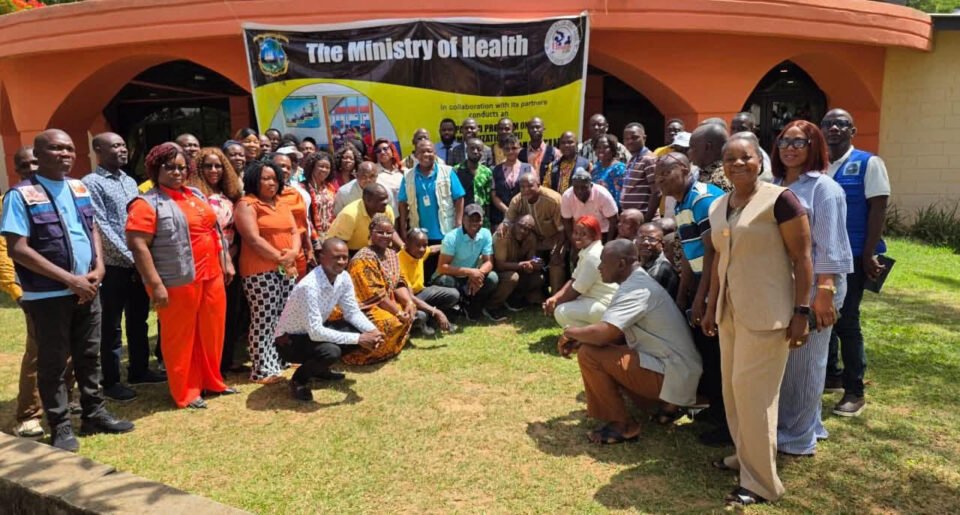
GRAND GEDEH COUNTY – The Ministry of Health (MOH) of Liberia, in collaboration with international partners, county health teams, and other county-level implementers of the Expanded Program on Immunization (EPI), has convened its annual review meeting to assess immunization performance for 2025 and the first quarter of 2026.
By: Kabina Kabah – kabinaskabah98@gmail.com
The review is being conducted in two phases, beginning in Zwedru, Grand Gedeh County, before moving to Kakata, Margibi County. Health teams from all 15 counties are participating to evaluate progress, identify gaps, and align priorities for the year ahead.
Decisions Must Translate Into Better Health Outcomes
Speaking at the opening of the first session in Zwedru on behalf of the Minister of Health, Dr. Louise M. Kpoto, Deputy Minister for Policy, Planning, and Monitoring & Evaluation (M&E), Atty. Malayah Tamba Chieyoe, urged stakeholders to ensure that decisions taken during planning and policy discussions lead to measurable improvements in the lives of Liberians.
She emphasized that the review provides a critical platform for collaboration and knowledge-sharing, while also strengthening professional relationships among participants.
“The decisions taken should not remain on paper,” she said, calling on stakeholders to remain committed throughout the planning process so that their contributions translate into improved service delivery and better health outcomes nationwide.
Funding Constraints and Unexplained Outbreaks
EPI Program Manager, Dr. Adolphus Clarke, described the meeting as a “critical moment” for Liberia’s immunization programme, pointing to shrinking financial support from Gavi and other immunization partners.
He noted that the Ministry of Health is working to close the funding gap by leveraging a Government-to-Government (G2G) Memorandum of Understanding between Liberia and the United States.
According to Dr. Clarke, the arrangement is expected to support key immunization activities that are currently underfunded, with strict monitoring and audit mechanisms in place.
“Once we receive full approval, we will inform stakeholders of the activities supported by the U.S. government,” he said.
Dr. Clarke also challenged county health teams to provide context-specific explanations for the persistence of disease outbreaks, despite reports of high vaccination coverage. He urged participants to uncover the “true causes” behind recurring measles outbreaks.
WHO Commends Decentralization, Warns on ‘Zero-Dose’ Children
Delivering remarks on behalf of the World Health Organization (WHO), Immunization Officer Dr. Tiala Korkpor Mulbah commended the Ministry of Health and the EPI unit for organizing the review, highlighting the importance of decentralization in improving healthcare delivery.
“Being here in Zwedru is a testament to the power of decentralization,” she said, noting that frontline health workers continue to deliver services despite limited resources and challenging terrain.
Dr. Mulbah stressed that immunization progress goes beyond statistics, reflecting real-life impact in protecting children, supporting mothers, and strengthening communities.
However, she warned that significant gaps remain, particularly among “zero-dose” children—those who have not received any vaccines.
“As long as those gaps exist, our job is not done,” she emphasized.
She reaffirmed WHO’s commitment to supporting Liberia’s immunization agenda and the global Immunization Agenda 2030 (IA2030), ensuring that no child is left vulnerable to preventable diseases.
UNICEF Supports Logistics and ‘Last Mile’ Delivery
Also speaking, UNICEF Grand Gedeh County Programme Officer Timothy Paulus highlighted UNICEF’s technical and logistical support to Liberia’s immunization efforts.
He said the organization’s support extends beyond funding to strengthening supply chains and cold chain systems, particularly in hard-to-reach areas.
Paulus noted that UNICEF is supporting the government’s “Last Mile” delivery strategy aimed at reaching children in remote communities, including zero-dose populations.
He cited the 2024 measles vaccination campaign, during which UNICEF-supported outreach teams reached 78,514 children in remote areas across all 15 counties.
He also highlighted UNICEF’s role in modernizing EPI data systems, noting collaboration with the Africa CDC to drive digital transformation within the programme.
In addition, Paulus pointed to UNICEF’s contribution to vaccine procurement, including the delivery of 112,000 doses of the RTS,S malaria vaccine in early 2024—marking a significant expansion of Liberia’s immunization portfolio.
Technical Discussions Across Key Areas
The EPI Annual Review Meeting includes in-depth technical discussions through breakout sessions covering data management, disease surveillance, service delivery, supply chain systems, community engagement, training, and programme administration.
The second phase of the review is expected to take place in Kakata, Margibi County, where stakeholders will continue county-level discussions to refine Liberia’s immunization priorities for the remainder of 2026.
