


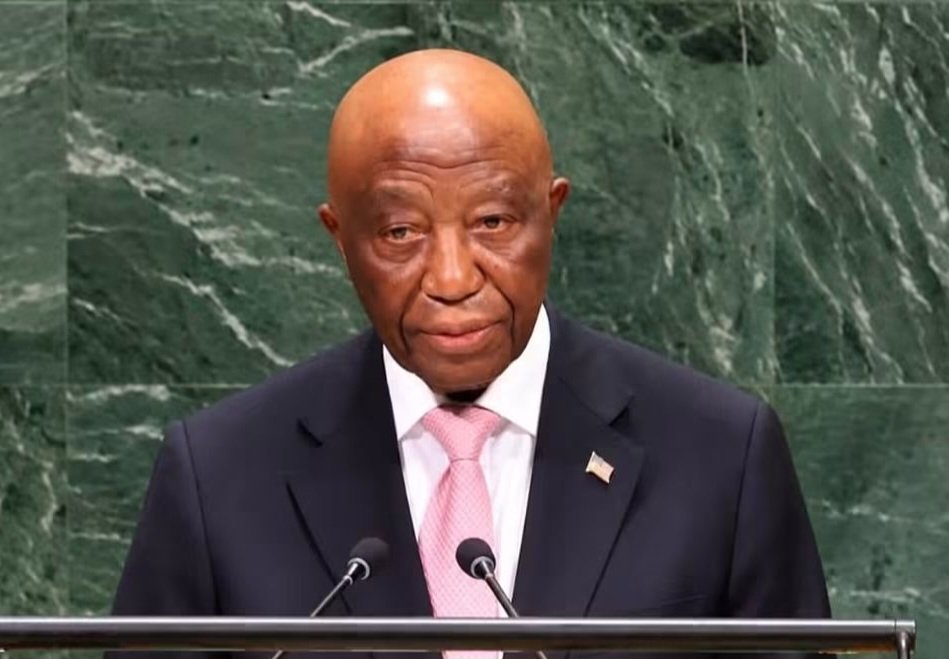
NEW YORK – President Joseph Nyuma Boakai has called for sweeping reforms to the international system, warning that declining trust in multilateralism is being fueled by what he described as the inconsistent and selective application of international principles.
By: Trokon S. Wrepue – trokon1992seokin@gmail.com
Addressing the 81st Session of the United Nations General Assembly in New York on Thursday, President Boakai said the answer to growing global fragmentation is not less multilateralism, but what he called “better multilateralism,” grounded in international law, human rights, dignity and inclusive development.
The Liberian leader, whose country is currently serving on the UN Security Council, urged an immediate end to armed conflicts, unhindered humanitarian access and respect for international humanitarian law.
He also called for greater investment in preventive diplomacy, mediation and early-warning systems, arguing that preventing conflict is less costly than rebuilding societies after war.
Boakai also highlighted Liberia’s efforts to combat transnational organized crime and illicit drug trafficking in West Africa, particularly along maritime routes in the Gulf of Guinea.
He appealed for international assistance in areas including coast guard surveillance, intelligence sharing and port-security technology, saying global criminal networks cannot be effectively addressed by individual countries acting alone.
On development, President Boakai called for structural reform of the international financial system, including greater access to concessional financing, debt sustainability and predictable development funding for poorer nations.
The Liberian leader argued that developing countries should have a greater voice and vote within the World Bank and International Monetary Fund, saying the governance structures of the Bretton Woods institutions still reflect the global realities of 1945 rather than those of today.
At the national level, Boakai highlighted his administration’s ARREST Agenda for Inclusive Development, which focuses on Agriculture, Roads, Rule of Law, Education, Sanitation and Tourism.
He pointed to revenue administration and infrastructure development, including rural roads intended to connect farming communities with markets, as areas where his government says progress has been made.
Climate change was another major issue in the Liberian president’s address. Boakai said Liberia contributes virtually nothing to global emissions but faces coastal erosion, flooding and disruptions to agricultural cycles.
President Boakai also emphasized Liberia’s role in protecting the Upper Guinean Rainforest and called on industrialized nations to honor climate-financing commitments and operationalize loss-and-damage mechanisms.
On democracy, gender equality and technology, Boakai called for greater investment in youth education, STEM, digital literacy and technical training.
He also reaffirmed Liberia’s commitment to political, economic and social equality for women and girls, while supporting international efforts to establish ethical rules governing artificial intelligence, particularly its use in warfare.
The strongest portion of the speech focused on reform of the UN Security Council. Boakai argued that Africa’s absence from the Council’s permanent membership represents a historic imbalance, noting that Africa has about 1.5 billion people and accounts for nearly one-third of UN membership, while a significant share of Security Council mandates concern African peace and security.
“Eighty years of patience is enough. The time for structural reform is now,” Boakai declared, reaffirming Liberia’s support for the Common African Position on Security Council reform. He said Africa should receive no fewer than two permanent seats, with the accompanying rights and responsibilities, including the veto for as long as the veto exists, alongside additional non-permanent seats.
Boakai maintained that giving Africa greater representation should not be viewed as a favor to the continent, but as part of efforts to restore the credibility, legitimacy and trust of the United Nations.
Concluding his address, the Liberian president challenged world leaders to decide whether multilateralism would continue drifting toward irrelevance or whether member states would take decisive steps to restore confidence in the international system.
He invoked Liberia’s own transition from civil conflict to constitutional democracy as evidence, in his framing, that institutions can be rebuilt when nations commit themselves to reform.
Boakai called for a United Nations that does more than deliberate on global crises, urging the organization to deliver concrete results, protect vulnerable populations, uphold the rights of nations and strengthen efforts to secure peace for future generations.
