


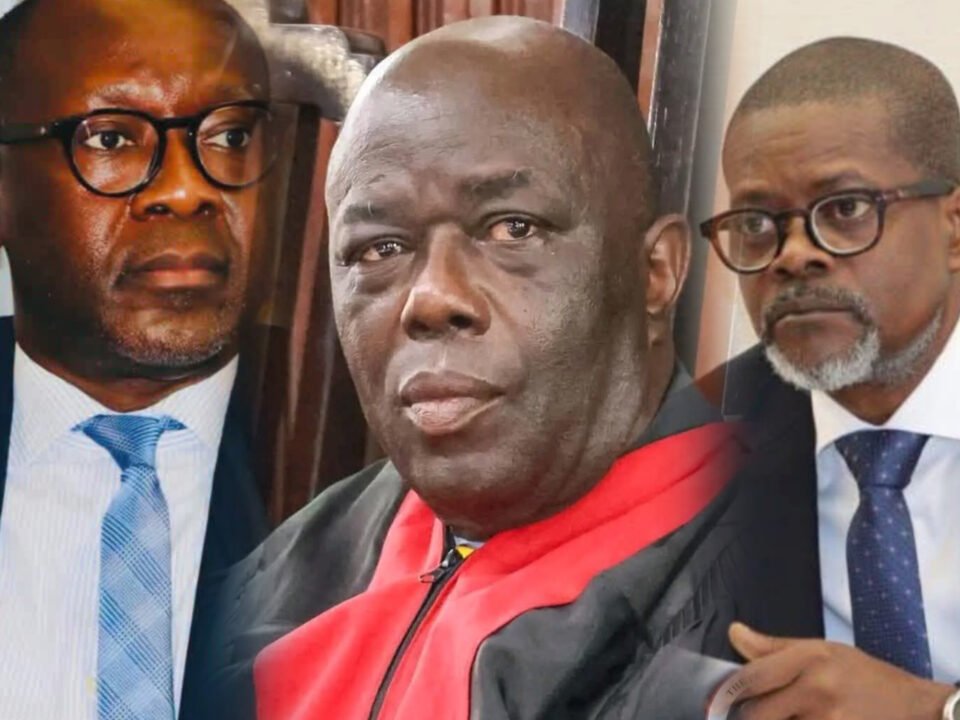
MONROVIA – Liberia’s justice system is facing a major constitutional debate following Chief Justice Yamie Quiqui Gbeisay Sr.’s call for the abolition of trial by jury, a proposal that has drawn strong opposition from Montserrado County Senator Abraham Darius Dillon and Gbarpolu County Senator Amara Konneh.
By: Trokon S. Wrepue – trokon1992seokin@gmail.com
The Chief Justice’s proposal, prompted by reported cases of jury tampering in several judicial circuits, has exposed sharp differences over how Liberia should confront corruption in the justice system without undermining constitutional protections.
While Gbeisay argues that jury interference threatens the credibility of trials and the fight against corruption, Senators Dillon and Konneh maintain that abolishing jury trials is neither the appropriate response nor a decision that can be made without following the constitutional amendment process.
Chief Justice: Jury Tampering Threatens the Administration of Justice
Chief Justice Gbeisay said the jury system was established as a safeguard of liberty, allowing citizens to be judged by their peers without threats or undue influence.
However, he warned that when juries become vulnerable to corruption, the institution intended to protect justice can instead undermine it.
“The jury system was conceived as a benchmark of liberty, the judgment of one’s peer, free from threat and undue influence. But when it is corrupt, it ceases to be a shield and becomes a sword against justice itself,” Gbeisay declared.
The Chief Justice cited reported incidents of jury tampering in several judicial circuits, including the Eighth Judicial Circuit in Nimba County in 2022.
He also referenced alleged jury interference in a rape case in the Seventh Judicial Circuit, identified in his statement as “Grand Jury County,” and another rape case in the Eleventh Judicial Circuit, identified as “Bone County.” According to his account, jury tampering in the latter case was reported 19 days after the acquittal.
Gbeisay further cited a drug case in the Thirteenth Judicial Circuit, identified in his statement as “Magill County,” where alleged jury tampering was reported while the trial was still pending.
The Chief Justice warned that the frequency of such incidents could undermine the successful prosecution of both civil and criminal cases if decisive action is not taken.
“These patterns and frequency clearly demonstrate that if nothing is done to arrest the way for jury tampering, there will be no successful trial, whether civil or criminal, in this jurisdiction,” he said.
Citing the impact of jury tampering on the justice system and the national fight against corruption, Gbeisay called on Liberians to abolish the trial jury system.
His proposal, however, has triggered a constitutional debate over whether the country should eliminate jury trials or strengthen the safeguards designed to protect them.
Dillon to Chief Justice: Fix Jury Corruption, Don’t Abolish the System
Montserrado County Senator Abraham Darius Dillon has strongly rejected the Chief Justice’s proposal, arguing that trial by jury is a fundamental constitutional right that cannot simply be eliminated through ordinary legislative action.
Dillon pointed to Article 20(a) of Liberia’s 1986 Constitution, which guarantees the right to trial by jury, and argued that abolishing the system would require a national referendum.
The senator maintained that the reported problem of jury tampering does not justify removing a constitutional protection. Instead, he argued that the judiciary should focus on enforcing existing laws and ensuring that those responsible for interfering with juries are held accountable.
“By suggesting that ‘jury-tampering’ hurts the intent and purpose for ‘trial by jury’, for which you are seeking ‘dissolution’ thereof, is simply exposing the weakness of our justice system and failure of the judiciary to decisively punish alleged doers of the act to serve as deterrent,” Dillon argued.
He further stressed that Liberia should not abandon laws and institutions simply because authorities have failed to enforce them effectively.
“We cannot simply seek to undo laws because of our failure to summon the courage to implement and enforce the laws,” he said.
In an analogy aimed at highlighting what he considers the weakness of the abolition argument, Dillon compared eliminating jury trials to burning down an entire house because a rat is causing trouble instead of finding a way to catch the rat and save the house.
The senator concluded that he fundamentally disagrees with abolishing the constitutional right to trial by jury, insisting that the appropriate response should be to confront corruption rather than remove the institution.
Konneh: Abolition Is Not the Answer; Reform the System
Gbarpolu County Senator Amara Konneh has also rejected the proposal, although he acknowledged that the Chief Justice deserves recognition for placing jury tampering and juror bribery at the center of the national debate.
Konneh said such practices undermine public confidence in the courts and can lead to acquittals that, in his assessment, defy the evidence presented during trials.
He argued, however, that the country must distinguish between the need to address corruption in the justice system and the constitutional requirements for abolishing jury trials.
“Before it is a policy question, it is a constitutional question,” Konneh stated.
The senator cited Article 20(a) of the 1986 Constitution, which guarantees an accused person the right to a speedy, public and impartial trial by a jury of the vicinity.
He further referenced Articles 91 and 92, arguing that removing the constitutional guarantee would require a constitutional amendment, approval by two-thirds of the Legislature and ratification by the Liberian people through a national referendum.
According to Konneh, the constitutional process exists to ensure that a right guaranteed to citizens cannot be removed without their consent through the prescribed legal procedures.
Beyond the constitutional concerns, Konneh warned that abolishing jury trials would not necessarily eliminate corruption from the courtroom.
“Corruption follows power,” he argued, cautioning that judges could also be bribed, intimidated or subjected to political pressure.
He said transferring decision-making power from juries to individual judges would not automatically prevent attempts to manipulate verdicts. Instead, he maintained that the government should strengthen the institutions and safeguards intended to protect the judicial process.
Konneh Proposes Stronger Juror Protection and Tougher Penalties
Rather than abolishing jury trials, Konneh has proposed a comprehensive reform program to address the vulnerabilities identified by the Chief Justice.
His recommendations include mandatory sequestration and anonymity for jurors in serious criminal cases, improved juror compensation and protection, a transparent and professionally managed jury-selection system, and prosecution of jury tampering as a standalone offence carrying mandatory custodial sentences.
Konneh argued that jurors must be protected from intimidation and corruption while receiving sufficient support to serve without fear.
He also called on the Chief Justice to submit a comprehensive Jury Reform Act to the Legislature, proposing public hearings and cooperation between the judiciary and lawmakers to develop lasting solutions.
“The jury is the only institution where ordinary Liberian citizens directly check the state’s power,” Konneh said, arguing that the country should strengthen that safeguard rather than eliminate it.
He acknowledged the Chief Justice’s concerns but maintained that abolition should not be the first response to a system facing corruption allegations.
“Fix the system. Do not end the right,” Konneh declared.
Liberia Faces a Critical Debate Over Justice and Constitutional Rights
The disagreement among the Chief Justice and the two senators has brought renewed attention to the integrity of Liberia’s judicial system and the constitutional protections governing criminal trials.
At the center of the debate is whether reported jury tampering should lead to the abolition of jury trials or prompt stronger enforcement, better protection for jurors and tougher penalties for those found guilty of interfering with judicial proceedings.
Gbeisay has warned that jury tampering threatens the possibility of successful trials, while Dillon and Konneh argue that eliminating jury trials would risk sacrificing a constitutional right instead of addressing the alleged misconduct.
The debate also raises questions about the judiciary’s ability to investigate and prosecute jury interference and whether proposed reforms could restore public confidence in verdicts.
As discussions continue, the challenge for Liberia’s judicial and legislative authorities will be to confront corruption, protect the constitutional rights of accused persons and ensure that verdicts are reached through a fair and impartial process.
