


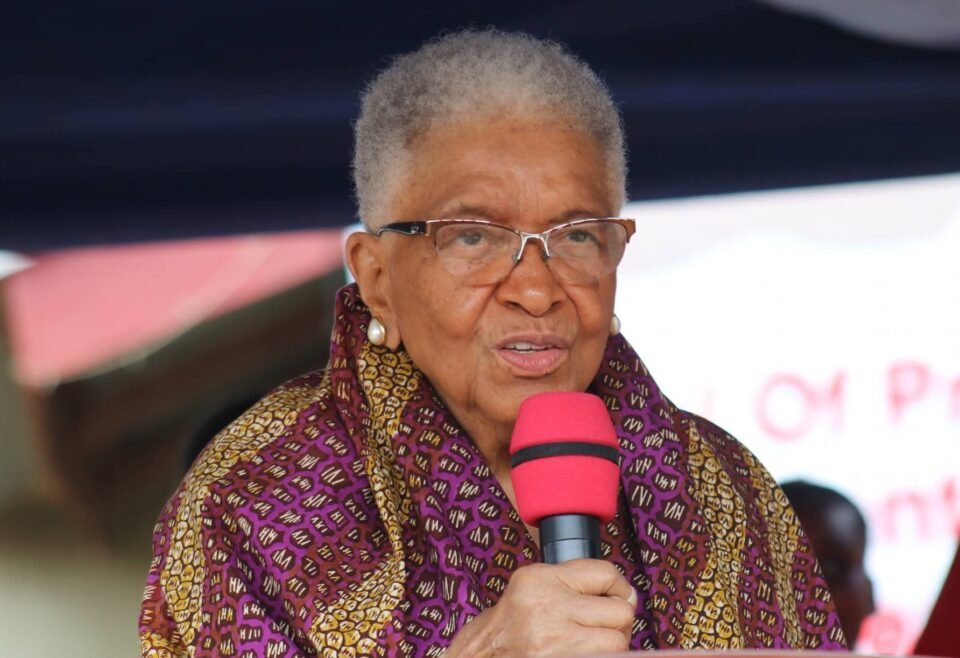
MONROVIA – Former President Ellen Johnson Sirleaf has acknowledged that her administration failed to effectively defeat corruption despite introducing a number of major governance and accountability reforms during her 12-year presidency.
By: Trokon S. Wrepue – trokon1992seokin@gmail.com
Sirleaf made the admission Tuesday, October 6, 2026, while delivering remarks at a symposium organized by the Governance Commission as part of Liberia’s inaugural Good Governance Month.
President Joseph Boakai proclaimed October 2026 as the Month of Good Governance, with activities focused on promoting transparency, accountability, integrity and effective public administration.
Speaking to government officials, governance actors and other participants, Sirleaf said she appeared not as a former president defending her record, but as a citizen reflecting on Liberia’s governance history and the lessons that should be drawn from it.
“I stand before you today as a citizen to talk the words of citizens. I once carried the responsibility that many of you carry now. We should draw our lessons from this history because we face the same thing today,” she said.
Sirleaf recalled assuming office in January 2006 at a time when Liberia was emerging from years of civil conflict and institutional breakdown. She said she declared corruption the country’s “public enemy number one” because her administration inherited what she described as a nation that had been looted and a population that had lost confidence in government institutions. She argued that rebuilding peace required restoring public trust in government.
According to the former president, her administration subsequently undertook a series of institutional reforms aimed at strengthening accountability and preventing the misuse of public resources.
Among them were efforts to strengthen the General Auditing Commission, the establishment of the Liberia Anti-Corruption Commission, and the development of the Governance Commission from the Governance Reform Commission established under the 2003 Accra Peace Accord.
Sirleaf also pointed to the establishment of the Public Procurement and Concessions Commission and the passage of Liberia’s Freedom of Information Act in 2010 as significant steps taken during her administration.
She said the reforms were accompanied by a team of professionals and high-integrity officials and contributed to what she described as achievements that were unexpected in the post-war period.
However, she acknowledged that the reforms did not translate into victory over corruption.
“That I could tell you that with all this effort, we won the corruption fight. We did not. And we are facing the same thing today,” Sirleaf said.
She further criticized the failure to consistently enforce accountability measures, saying some government orders were issued but later abandoned, while only a limited number of corruption cases reached the courts and even fewer resulted in convictions.
“Orders were published and then forgotten. Too few cases reached a courtroom and few ended in conviction,” she said.
Her remarks come as Liberia renews its focus on governance and anti-corruption measures. The government has announced several initiatives under the October Good Governance Month, including the National Integrity Index, citizen scorecards and a Scientific Governance Barometer intended to assess public-sector performance, integrity and accountability.
Sirleaf stressed that accountability must extend beyond government institutions and include ordinary citizens. She said transparency is meaningful only when citizens have access to information and the ability to question those entrusted with public authority.
“There can be no accountability without inclusion,” she said. “Leaders are accountable only to those who develop or have the power to question them. Transparency matters only when every citizen can see and every citizen is counted.”
The former president also argued that the principles of accountability and responsible leadership are not foreign concepts imposed on Liberia by international partners. Instead, she said, they are rooted in Liberia’s own traditional understanding of leadership, where authority was regarded as a trust that could ultimately be withdrawn.
“Leadership is trust and can be withdrawn. Good governance is not an input. It is a return to values,” Sirleaf declared.
She further reflected on constitutional reform efforts undertaken during her administration, saying her government sought to align Liberia’s policies and citizenship framework more closely with practices in other African countries. However, she acknowledged that those efforts did not succeed.
Sirleaf’s admission adds a notable dimension to Liberia’s current governance debate, particularly as the country seeks to strengthen institutions responsible for auditing public funds, investigating corruption, enforcing procurement rules and ensuring access to government information.
Earlier this year, Sirleaf also called for stronger accountability mechanisms, including a specialized anti-corruption court, arguing that Liberia’s anti-corruption fight requires institutions capable of ensuring that cases are effectively prosecuted and justice consistently served.
Her latest remarks therefore place renewed emphasis on a central challenge that has persisted across successive administrations: creating strong accountability institutions is not enough unless corruption cases are investigated, prosecuted and resolved through an effective justice system.
As Liberia observes its first Good Governance Month, Sirleaf’s reflection challenges current leaders and citizens to examine not only the reforms introduced over the years, but also why those reforms have struggled to produce lasting accountability.
