


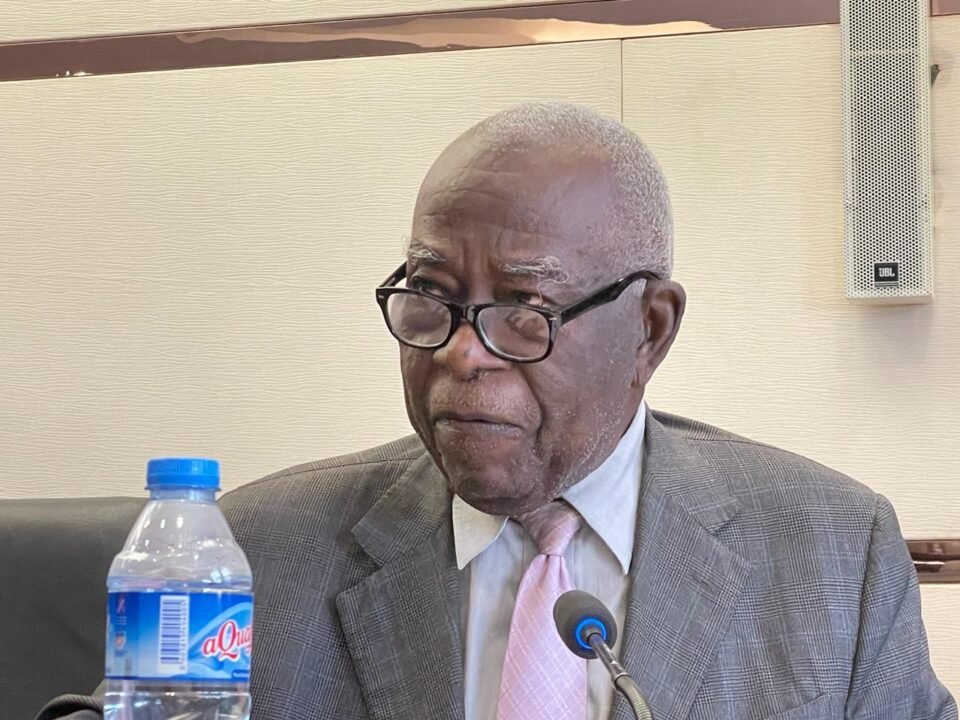
MONROVIA – Cllr. Lavela Supuwood has questioned the constitutional and legal basis for prosecuting individuals for atrocities committed during Liberia’s civil wars, warning lawmakers that the establishment of a Special War Crimes Court must not violate fundamental constitutional protections against retroactive criminal punishment.
By Sampson W. Weah – sampsonwweah7@gmail.com
Speaking during a public hearing on the harmonized and revised bills seeking to establish the Special War Crimes Court for Liberia (SWACCOL) and the National Anti-Corruption Court, Supuwood argued that while accountability for past atrocities and corruption remains important, legislative actions must conform to the Constitution and established principles of criminal justice.
Making his submission before lawmakers, Supuwood referenced a Supreme Court ruling involving former House Speaker J. Alex Tyler, which examined provisions of the Truth and Reconciliation Commission (TRC) Act and the legal implications of implementing the commission’s recommendations.
He particularly drew attention to the Court’s determination that Section 48 of the TRC Act, which sought to make the implementation of all TRC recommendations mandatory, was unconstitutional and unenforceable.
According to Supuwood, the ruling raises important constitutional considerations regarding attempts to establish criminal liability for conduct committed before the enactment of the proposed legislation.
He emphasized that the principle of legality remains a fundamental safeguard in criminal justice, arguing that lawmakers cannot introduce criminal provisions today and apply them retrospectively to punish individuals for actions that were not criminal offenses under the applicable law when committed.
“We cannot pass a law today to penalize yesterday,” Supuwood declared, underscoring what he considers a significant constitutional obstacle in the proposed prosecution of individuals for alleged crimes committed during Liberia’s civil conflict.
He explained that although the Legislature has the authority to enact laws governing future conduct, such authority must be exercised within constitutional limits, particularly where criminal punishment is concerned.
Beyond the constitutional questions, Supuwood cautioned that prosecuting alleged wartime crimes decades after their occurrence could present serious evidentiary challenges, including difficulties in establishing individual responsibility and obtaining reliable evidence.
Referencing the prosecution of former Liberian President Charles Taylor before the Special Court for Sierra Leone, he highlighted the importance of establishing criminal responsibility through credible and admissible evidence.
He explained that Taylor’s conviction was based on his criminal responsibility for aiding and abetting crimes committed by the Revolutionary United Front (RUF), rather than a finding that he personally carried out every crime for which he was initially charged.
For Supuwood, the experience demonstrates the complexities associated with prosecuting individuals for crimes committed during armed conflict and the necessity of meeting the required legal standards.
Supuwood Opposes Duplication of Anti-Corruption Institutions
Turning to the proposed National Anti-Corruption Court, Supuwood questioned whether establishing another judicial institution would provide the most effective solution to Liberia’s persistent corruption challenges.
He argued that the country’s major problem is not necessarily the absence of institutions mandated to address corruption, but the failure to adequately empower existing structures to perform their responsibilities.
He identified the Ministry of Justice and the Liberia Anti-Corruption Commission (LACC) as key institutions within the country’s anti-corruption framework, maintaining that their effectiveness continues to be affected by inadequate funding, limited manpower, and insufficient institutional capacity.
Supuwood also referenced Criminal Court ‘C’, which has jurisdiction over theft and related offenses, questioning why additional judicial structures should be prioritized when existing courts and prosecutorial institutions require greater support.
He expressed particular concern about the proposed five-year operational lifespan of the National Anti-Corruption Court, questioning whether such a limited period would be sufficient to handle complex corruption investigations, lengthy trials and related judicial proceedings.
In his view, Liberia should first invest in strengthening the Ministry of Justice by increasing its budgetary allocation, recruiting additional prosecutors and providing the resources necessary to improve the prosecution of criminal cases.
“The effort is honorable, but I think that we should emphasize strengthening the Ministry of Justice,” he told lawmakers.
He further argued that creating another institution to perform responsibilities already assigned to existing agencies could result in overlapping mandates and unnecessary duplication within the justice system.
According to him, the constitutional structure of government already establishes the responsibilities of the various institutions, making institutional strengthening a more practical approach than expanding the number of agencies without addressing existing operational weaknesses.
Calls for Stronger Existing Institutions
Supuwood maintained that the fight against corruption and the pursuit of accountability must be supported by institutions with the necessary resources, qualified personnel, and political commitment to enforce the law.
He urged lawmakers to critically assess the performance of existing institutions and address their shortcomings before committing public resources to establishing additional judicial structures.
His submission placed constitutional compliance, prosecutorial capacity and institutional accountability at the center of the legislative debate, presenting a position that challenges both the proposed approach to prosecuting historical wartime crimes and the creation of another anti-corruption court.
While recognizing the importance of addressing impunity and corruption, Supuwood maintained that legislative reforms must be legally sound, constitutionally consistent, and capable of producing meaningful results for the country.
The public hearing forms part of the Legislature’s consideration of the revised bills intended to establish specialized judicial mechanisms for addressing wartime atrocities and corruption-related offenses in Liberia.
