


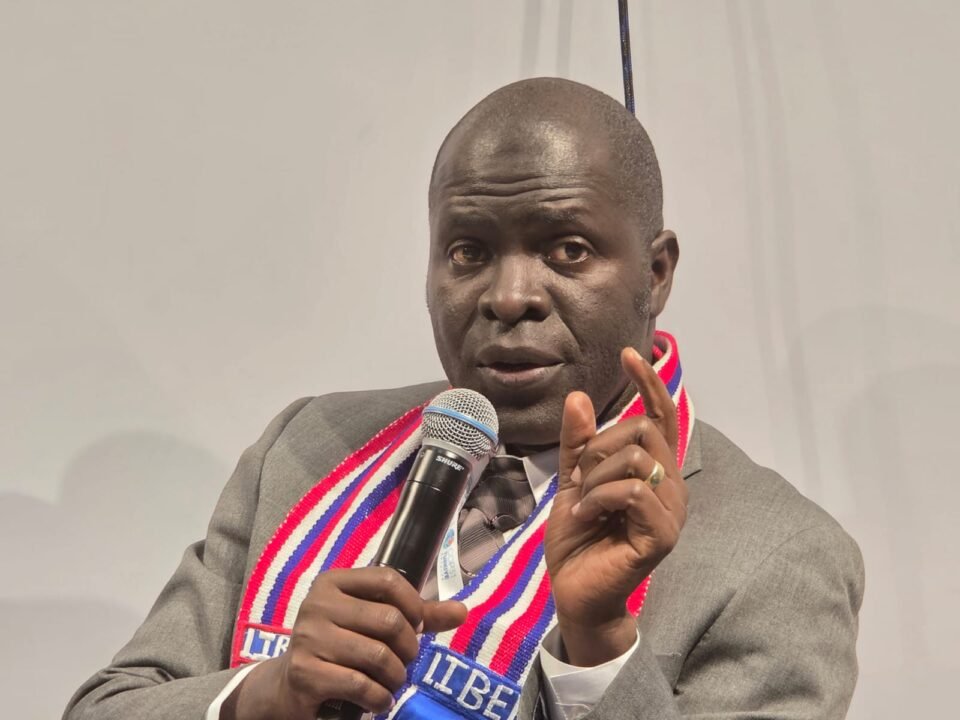
EPA Executive Director Dr. Emmanuel Urey Yarkpawolo says developed nations must cut greenhouse gas emissions and provide grant-based financing to vulnerable countries, warning that the survival of humanity is at stake.
ANTALYA, TURKEY – Liberia has intensified its call for climate justice at the 31st Conference of the Parties (COP31), demanding increased international climate financing and urgent action from major greenhouse gas emitters to address the growing threats of global warming.
By: Trokon S. Wrepue – trokon1992seokin@gmail.com
Executive Director of the Environmental Protection Agency of Liberia (EPA) and head of Liberia delegation at COP31, Dr. Emmanuel Urey Yarkpawolo, says developed countries must fulfill their financial commitments to developing nations, particularly those in Africa, which contribute minimally to global emissions but continue to experience the devastating consequences of climate change.
Speaking in an interview at COP31 in Antalya, Turkey, Dr. Yarkpawolo emphasized that climate change is no longer a distant environmental concern but a growing threat to food security, livelihoods, coastal communities, and human survival.
He explained that global warming, largely driven by human activities such as burning fossil fuels and deforestation, is disrupting weather patterns, causing unpredictable rainfall, prolonged dry periods, and rising sea levels.
According to him, these changes are making agricultural production increasingly difficult, as farmers can no longer reliably predict rainfall and sunshine, resulting in reduced food production and heightened risks of hunger.
Dr. Yarkpawolo also warned that rising sea levels and coastal erosion pose serious threats to Liberia’s coastal communities, including West Point in Monrovia, Robertsport in Grand Cape Mount County, and Buchanan in Grand Bassa County.
He noted that the international climate conference provides an important platform for countries to negotiate collective responses to the crisis through two major approaches: mitigation and adaptation.
While mitigation involves reducing greenhouse gas emissions and protecting forests that absorb carbon, adaptation focuses on helping communities adjust to the consequences of climate change.
Citing Liberia’s ongoing interventions, the EPA Executive Director pointed to seawall construction in vulnerable coastal communities and agricultural innovations at the Central Agricultural Research Institute (CARI), where collaboration with the International Atomic Energy Agency has helped develop a more resilient rice variety that reduces the production cycle from approximately 120 days to 80 days.
He said such innovations are essential to helping Liberian farmers maintain food production even when rainfall becomes unpredictable.
However, Dr. Yarkpawolo stressed that implementing these measures requires substantial financial resources that Liberia and other developing countries cannot independently provide.
He referenced the Paris Agreement, particularly Article 9, which establishes financial obligations for developed countries to support developing nations in addressing climate change.
The EPA chief said Liberia is therefore demanding predictable, grant-based adaptation financing and operational funding for loss and damage to compensate communities suffering destruction from climate-related disasters.
He explained that loss and damage financing is particularly important for families whose homes and livelihoods are destroyed by coastal erosion and other climate disasters, despite having contributed little to the emissions responsible for global warming.
Dr. Yarkpawolo disclosed that Liberia is also advancing several strategic priorities at COP31, including equitable climate financing, its Nationally Determined Contribution (NDC 3.0), nature-based solutions, renewable energy development, and the protection of the Upper Guinean Forest.
Under its proposed NDC 3.0, Liberia aims to reduce its greenhouse gas emissions by 64 percent by 2035, a target he said would require significant investment in renewable energy, including hydropower and solar energy, as the country transitions away from fossil fuel dependence.
He further emphasized the importance of protecting the Upper Guinean Forest, noting that Liberia holds more than 43 percent of the remaining forest cover in West Africa.
According to him, preserving the forest must also translate into improved living conditions for communities that depend on it, including better access to education, roads, electricity, and sustainable livelihoods.
Dr. Yarkpawolo maintained that forest conservation cannot succeed without providing tangible economic benefits to the people living in and around forest communities.
Meanwhile, the EPA Executive Director disclosed that Liberia is working alongside other African countries and members of the Least Developed Countries group to push for increased adaptation financing at the global negotiations.
He confirmed that Liberia was selected as one of four Least Developed Countries representatives to meet with United Nations Secretary-General António Guterres, during which they highlighted the need to triple adaptation financing by 2035.
He said the proposed increase translates into approximately 1.3 trillion United States dollars for Least Developed Countries, including vulnerable nations in Africa, South Asia, and small island states.
Dr. Yarkpawolo also highlighted Africa’s limited contribution to the climate crisis, stating that the continent accounts for less than four percent of global greenhouse gas emissions, despite facing severe climate-related challenges.
He argued that the burden of addressing climate change must therefore not fall disproportionately on countries that have contributed least to the problem.
When asked about the two practical measures needed to move the global climate negotiations forward, Dr. Yarkpawolo called for major emitters to immediately reduce their greenhouse gas emissions and for financially capable countries to provide substantial grant-based support to vulnerable nations.
He cautioned against providing loans to already indebted developing countries, arguing that additional borrowing would only increase their financial burdens and transfer the consequences to future generations.
“Give credit, don’t give loan,” he stressed, insisting that grants are necessary to help vulnerable countries strengthen their resilience without accumulating more debt.
The EPA Executive Director further warned that major emitting countries have no choice but to take decisive action, describing climate change as a question of humanity’s survival.
“The question is, we as human beings, will we continue to exist within the earth? Or our activities will drive us into extinction and the earth will continue to exist,” Dr. Yarkpawolo stated.
He acknowledged that some major emitters remain divided in the ongoing negotiations but maintained that the scientific evidence of climate change and its consequences is already clear.
Beyond the negotiations, Dr. Yarkpawolo said Liberia is using its national pavilion at COP31 to strengthen international partnerships, promote investment opportunities, and showcase the country’s environmental and economic potential.
He disclosed that several Liberian government officials, including the Legal Advisor to the President and the Minister of Public Works, are participating in the conference.
He also revealed that Liberia’s Minister of Public Works and his Ghanaian counterpart signed an agreement at the Liberian pavilion focused on mobilizing financing for green infrastructure.
According to him, the pavilion has also provided opportunities for government institutions, international partners, and civil society organizations to exchange ideas, establish partnerships, and explore practical climate solutions.
Dr. Yarkpawolo said Liberia has additionally developed a conference guide for its delegates and is promoting the country’s Natural Capital Atlas to highlight investment opportunities in green infrastructure, forest conservation, biodiversity, and sustainable economic development.
As COP31 focuses on moving beyond climate policy commitments toward actual implementation, Liberia’s message remains centered on climate justice: major emitters must reduce their pollution, while developed nations must provide the financing vulnerable countries need to adapt and protect their people.
For Liberia, the EPA chief emphasized, the country’s participation in the negotiations is critical because its voice and priorities must be heard in decisions that will shape the global response to climate change.
