


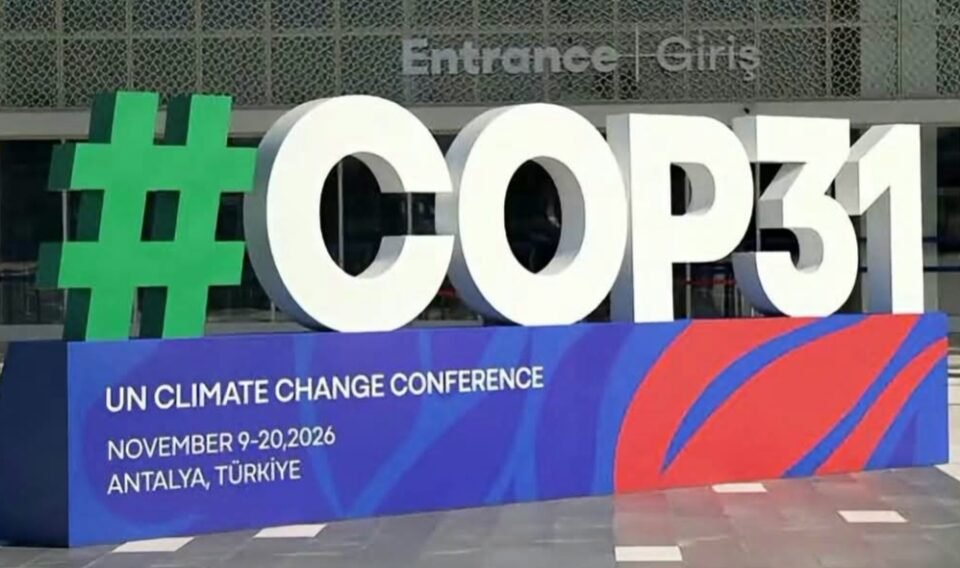
ANTALYA, TURKEY – Liberia has renewed its call for predictable and accessible international climate financing following the conclusion of the United Nations Climate Change Conference, COP31, in Antalya, Türkiye, without an agreement on its main proposed outcome, the Antalya Pact.
By: Trokon S. Wrepue – trokon1992eokin@gamil.com
The Environmental Protection Agency (EPA) of Liberia says governments remained divided over fossil fuels and climate finance, forcing negotiations to continue for two additional days without reaching consensus on the proposed political agreement intended to guide global climate action after the summit.
Despite the setback, Liberia used the negotiations, high-level engagements and its national Pavilion to push for stronger international commitments to climate financing and advance cooperation on climate-resilient infrastructure, agriculture and forest conservation.
One of the major disagreements centered on the inclusion of explicit language on fossil fuels in the final draft of the Antalya Pact. The European Union, Panama and other countries objected to a draft that omitted such references, while Saudi Arabia and other major oil-producing nations opposed including the language.
The disagreement focused on how countries should implement the 2023 Dubai decision calling for a transition away from fossil fuels in energy systems. Although the Antalya Pact was not adopted, the previous Dubai decision remains in effect.
Climate finance also emerged as a major sticking point, particularly the implementation of the commitment made at COP30 in Brazil to at least triple adaptation finance by 2035.
Liberia called for a clear starting figure, measurable milestones and public tracking to ensure that vulnerable countries receive the resources needed to respond to climate impacts. However, the final draft only retained the commitment to triple adaptation finance while proposing further discussions on establishing a starting figure.
According to the EPA, the failure to adopt the Antalya Pact leaves Liberia and other climate-vulnerable countries without the clear delivery plan they had been seeking.
Nevertheless, countries reached agreements on some specific issues, including advancing work on a just transition, which seeks to ensure that workers and communities benefit from the shift toward cleaner economies.
For Liberia, the initiative presents opportunities to train technicians to install and maintain solar energy systems as the country works to expand electricity access.
Another development was the launch of a voluntary electrification initiative aimed at increasing electricity’s share of global energy use to 35 percent by 2035. The initiative focuses on strengthening electricity grids and expanding access, creating opportunities for Liberia to pursue partnerships in solar mini-grids, reliable electricity for health facilities and cleaner power for businesses currently dependent on diesel generators.
Beyond the formal negotiations, Liberia’s national Pavilion provided a platform for government institutions, civil society organizations, community representatives and development partners to discuss practical responses to climate challenges.
On its opening day, Liberia hosted three sessions focusing on food security, youth leadership in agriculture and the role of fair natural resource governance in sustaining peace. The discussions highlighted the challenges facing farming communities and the importance of young people in advancing the country’s climate response.
At the Pavilion, Liberia and Ghana signed an agreement aimed at mobilizing financing for green infrastructure.
In a separate engagement, the Ministry of Public Works highlighted its partnership with Conservation International to promote approaches that combine natural solutions, including wetlands and vegetation, with conventional engineering to strengthen infrastructure against flooding and other climate-related threats.
Liberia also used its national statement to demand predictable, accessible and predominantly grant-based international support for climate adaptation and loss and damage.
The EPA’s Executive Director, Dr. Emmanuel K. Urey Yarkpawolo, joined representatives of the Least Developed Countries Group in a high-level meeting with United Nations Secretary-General António Guterres, where he emphasized the global importance of Liberia’s forests and the need for adequate international support to protect them.
The group also called for faster global emissions reductions and increased grant-based assistance to countries facing the devastating consequences of climate change.
The EPA says such financing has direct implications for communities across Liberia. For families and fishers in West Point, adaptation funding could help protect homes, fishing landing sites and livelihoods, while farmers could benefit from improved water management systems and timely rainfall information.
The agency emphasized that grant financing is particularly important because it can support climate resilience projects without increasing the country’s debt burden.
Existing international financing mechanisms, including the Green Climate Fund, remain available to support such interventions. Liberia’s coastal resilience project in Sinoe County, supported by the Global Environment Facility and the United Nations Development Programme, is cited as an example of how international assistance can help protect vulnerable communities, including residents of Greenville.
Meanwhile, Liberia’s Nationally Determined Contribution, known as NDC 3.0, targets a 64 percent reduction in greenhouse gas emissions by 2035 compared with projected emissions levels without additional climate action.
The country has committed to financing a 10 percent reduction through its own resources, while the remaining 54 percentage points depend on international climate support.
The EPA says it will work with national institutions and development partners to follow up on engagements reached in Antalya and advance proposals covering coastal protection, early warning systems and climate-resilient agriculture.
Liberia will also continue collaborating with African nations and other least developed countries to advocate for an adaptation finance plan with clear timelines and public reporting mechanisms, allowing communities to track when climate funding arrives and the results it delivers.
Although COP31 ended without agreement on the Antalya Pact, Liberia says its engagements have reinforced the country’s demand for climate justice, stronger international cooperation and financial support to protect vulnerable communities and natural resources.
