


NATIONAL NEWS
G. BASSA COUNTY – The Liberian Agricultural Company (LAC), one of Liberia’s oldest concession companies, is facing growing criticism from prominent sons of Grand Bassa County and other Liberians over the construction and dedication of a 100-foot footpath bridge in one of its surrounding communities.
By: Trokon S. Wrepue – trokon1992seokin@gmail.com
Critics have questioned whether the project reflects the level of investment expected from a company that has operated in Liberia for more than six decades.
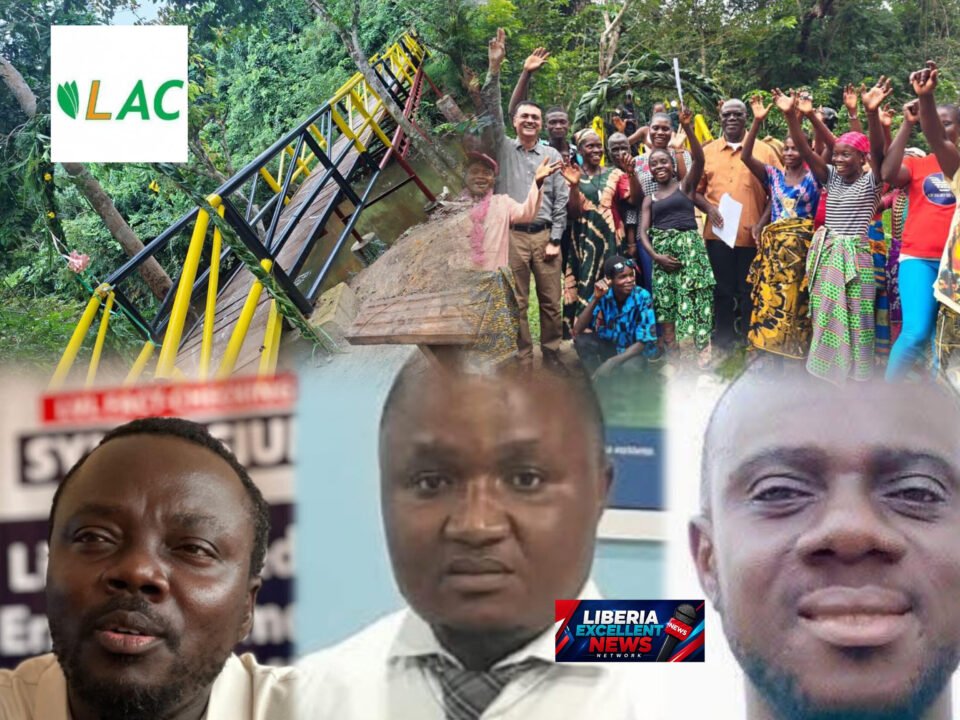
The controversy erupted after LAC announced the dedication of a newly constructed bridge over the Newcess River, linking Jocey Gargar Town and surrounding communities to schools, markets and healthcare facilities that the company said were previously cut off during periods of seasonal flooding.
According to LAC, the bridge ends decades of disruption for women, traders and school-going children who were often stranded for days during the rainy season.
The company described the project as an important intervention in its host communities, while Chief Elder Philip G.G. Gargar, speaking at the dedication, said: “Today, that struggle ends. This bridge is a symbol of hope for our people.”
But what LAC presented as a symbol of progress has instead triggered a broader debate over what constitutes meaningful corporate social responsibility in communities that have hosted large-scale commercial operations for generations.
Critics say the central issue is not whether the bridge is useful. Rather, they argue that after more than 65 years of commercial operations, the question should be whether LAC’s investments in its surrounding communities are proportional to the scale and longevity of its presence.
‘Is This Really What Six Decades Should Produce?’
Among those raising concerns is an accountant, Aaron A. Zoegar, who said corporate social responsibility should not be reduced to symbolic projects or interventions that merely meet minimum expectations.
Zoegar acknowledged that the bridge is useful but argued that its design limits its wider economic and emergency-response value because it is too narrow to accommodate vehicles.
For him, development should be measured by the impact infrastructure creates rather than by the ceremony accompanying its dedication.
“Development is not simply about building something but it is about building the right thing,” Zoegar argued, saying host communities deserve infrastructure capable of supporting economic growth, emergency response and lasting opportunities.
His criticism goes to the heart of the controversy: whether LAC should be applauded simply for constructing a bridge that solves one immediate problem or challenged to pursue larger infrastructure projects capable of transforming entire communities.
Journalist Wremongar B. Joe II was considerably more blunt. Joe said his criticism was not intended merely to attack LAC but to force an honest conversation about the company’s historical footprint in Grand Bassa.
He questioned whether a company that has operated in the county since 1959 should still be receiving praise for what critics describe as modest community interventions.
Joe also raised questions about land arrangements, wages, training opportunities and what he described as limited visible investment in education, healthcare and infrastructure.
His argument is that corporate responsibility should not be confined to what a concession agreement legally requires.
“LAC has been in Grand Bassa since 1959. For over six decades, you have operated in our county under what many consider an outdated concession arrangement, one that places very limited obligations on the company. No land rental fees. No meaningful contribution to county social development. No significant investment in affected communities. No training programs for staff. Undignified wages for many workers. Little to no visible impact in education, health, and infrastructure. Doing the right thing does not always require a clause in a concession agreement,” Joe said.
He challenged both LAC and the county’s political leadership, arguing that elected officials have a responsibility to demand greater benefits for communities affected by concession operations.
The Political Leadership Question
The controversy has also opened another uncomfortable discussion: where does responsibility lie between concession companies and government?
Reuben Dyukudyu Joe questioned why, after more than six decades of LAC’s operations, communities are still celebrating projects that critics believe should have been delivered years ago.
He also expressed surprise that no senator or representative was reportedly present at the bridge dedication, arguing that elected officials should be demanding more ambitious development projects for their constituents.
His criticism raises a larger issue confronting concession-host communities across Liberia: whether elected leaders are sufficiently aggressive in negotiating better development outcomes for citizens whose communities sit alongside commercial operations.
The debate therefore extends beyond LAC. It raises questions about government oversight, concession agreements, community engagement, corporate responsibility and the ability of local leaders to ensure that natural resources translate into visible improvements in the lives of surrounding populations.
But Is LAC Really Doing Nothing?
While the criticism has been fierce, a complete assessment of LAC’s presence in Grand Bassa requires more than the controversial bridge.
Available information about the company’s current community activities shows that LAC is involved in several areas beyond the construction of the Newcess River footbridge.
The company operates a school and a hospital, with the healthcare facility serving LAC employees and their families while also providing services to other residents who travel from different parts of the district for medical attention.
LAC also provides annual scholarships to deserving students, enabling beneficiaries to pursue university education at institutions of their choice at the end of the school year.
These interventions complicate the argument that the company has made little or no contribution to the social development of its surrounding communities.
The company’s Community Liaison and HSE Superintendent, J. Morris Saah, has also defended LAC’s community engagement efforts, saying management continues to work to close the development gap between the plantation and surrounding communities.
According to Saah, LAC has supported communities through the provision of safe drinking water, installation of solar lights, construction and maintenance of roads and bridges.
At the bridge dedication, LAC General Manager Naveen Madan similarly emphasized that the company’s development responsibility extends beyond the plantation.
“Development must extend beyond the plantation. We remain committed to supporting education, healthcare, infrastructure, and sustainable livelihoods,” Madan said.
The company also honored Saah by naming the newly dedicated bridge after him, with community leaders citing his efforts to build relationships between LAC and surrounding communities.
The Zondo Market: A Different Picture
Perhaps one of the strongest counterpoints to the criticism surrounding the bridge is the ongoing collaboration between LAC and Grand Bassa County District #5 Representative Thomas A. Goshua II to construct a modern market for residents of Zondo.
The project, unlike a simple footpath crossing, has the potential to become a more substantial economic intervention by creating a structured space for traders and residents while supporting commerce within the community.
The company says the partnership is significant because it demonstrates that LAC’s relationship with host communities is not limited entirely to small-scale infrastructure.
It also points to what many critics are actually demanding: development projects that create sustained economic opportunities rather than interventions that simply address an immediate physical problem.
The Zondo market, if completed to modern standards and properly maintained, could provide the kind of community infrastructure that critics say should become more common in LAC’s operational areas.
The Real Question Is Not Whether the Bridge Matters
At the center of the controversy is a legitimate tension. For residents of Jocey Gargar Town and nearby communities, the bridge may be enormously important.
A narrow bridge that allows children to reach school, women to access markets and residents to reach healthcare facilities during the rainy season can represent a major improvement in daily life.
A community that was previously cut off by flooding does not necessarily measure development by the size of the project. For those residents, accessibility itself can be transformative.
But for critics looking at LAC from the broader perspective of more than six decades of operations, the bridge represents something different.
They see it as a test of whether the company’s community investments have kept pace with its longevity, commercial footprint and the expectations of host communities.
For some, the bridge can be useful and still be inadequate. Both arguments can exist at the same time.
Beyond the Ceremony
The strongest criticism facing LAC is therefore not necessarily that it built a bridge. It is that after more than 65 years in Liberia, communities want to see a much bigger and more measurable development footprint.
“They want roads that remain accessible throughout the year. They want durable bridges. They want better schools. They want healthcare facilities capable of serving communities beyond company employees. They want scholarships to expand. They want vocational and skills training. They want opportunities for young people. They want markets that can stimulate local commerce. And they want communities hosting commercial operations to feel that the resources leaving their land are translating into tangible improvements in their quality of life. Those expectations are not unreasonable,” a senior employee who wants his identity hidden told Liberia Excellent News Network in a telephone conversation.
At the same time, LAC’s school, hospital, scholarships, water projects, solar lighting, roads, bridges and partnership on the Zondo market demonstrate that the company is not completely absent from the social-development landscape.
The more difficult question is whether the scale, quality and sustainability of those interventions are sufficient.
A New Standard for LAC?
The backlash over the Newcess River bridge may ultimately provide LAC with an opportunity rather than simply a public-relations problem.
Instead of dismissing the criticism, the company could use it to open a broader conversation with host communities about what they consider priority investments.
LAC could publish a clear account of its annual community-development spending, scholarship beneficiaries, healthcare services, infrastructure projects, employment and training programs, and the communities benefiting from them.
Such transparency would allow the public to judge the company’s contribution based on evidence rather than social-media arguments.
It would also help answer the most important question now hanging over the company:
After more than six decades in Grand Bassa, what should LAC’s next 10 years of community development look like?
For the residents of Jocey Gargar Town, the newly constructed bridge may indeed be a symbol of hope.
But for many critics across Grand Bassa and Liberia, it is also a symbol of a much larger question, whether six decades of commercial activity should produce a development legacy that is far more ambitious, durable and transformative.
The challenge before LAC, therefore, is not simply to defend one bridge.
It is to demonstrate, project by project and community by community, that the value generated from its long presence in Liberia is producing a legacy that the people of Grand Bassa can see, use and proudly claim as their own.
