


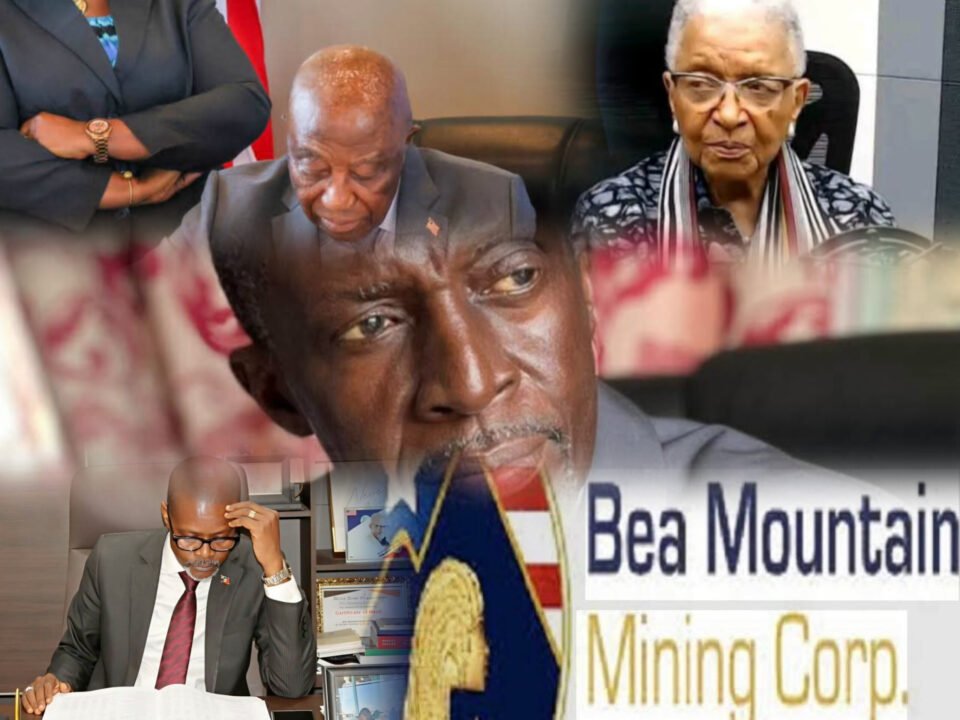
Former President Ellen Johnson Sirleaf and opposition leader Cllr. Tiawan Gongloe raise questions over financing, public revenue and environmental safeguards, while Senator Abraham Darius Dillon calls for independent scrutiny when the agreement reaches the Legislature….
MONROVIA – President Joseph Nyuma Boakai has signed a controversial US$5.7 billion Master Infrastructure Development Agreement (MIDA) with Bea Mountain Mining Corporation, committing his administration to an ambitious infrastructure program aimed at transforming Liberia’s road and energy sectors over the next five years.
By: Trokon S. Wrepue – trokon1992seokin@gmail.com
The agreement, signed on Wednesday, November 25, 2026, is being presented by the government as a major step toward addressing Liberia’s longstanding infrastructure challenges.
However, it has already attracted criticism and caution from former national leaders, opposition politicians and other stakeholders, who are demanding greater transparency and independent scrutiny of its financial arrangements, potential debt implications and long-term consequences for the country.
Speaking at the signing ceremony, President Boakai described the agreement as a historic milestone in Liberia’s development journey, commending government officials and other stakeholders for what he called their collective efforts and extensive negotiations leading to the deal.
The President emphasized the importance of placing national interest above political and individual differences, arguing that the country’s development challenges require collective commitment and cooperation.
The US$5.7 billion agreement is structured around four major infrastructure projects, with its central objectives being to expand electricity generation, strengthen the national power transmission network and improve road connectivity across the country.
Under the energy component, the program provides for major water infrastructure development, including four new power plants expected to generate at least 1,000 megawatts of electricity, alongside improvements to Liberia’s national transmission network.
The agreement also provides for 14 major road and bridge projects intended to improve transportation, connect communities and strengthen economic activities across the country.
President Boakai said the projects would significantly improve access to reliable electricity for households, schools, health facilities and businesses while creating employment opportunities and stimulating economic growth.
He further argued that improved road networks and electricity supply would strengthen agricultural production, reduce post-harvest losses and encourage investment outside Monrovia, where infrastructure limitations have continued to constrain economic activities.
Government defends financing arrangement
Addressing concerns surrounding the financing of the agreement and its possible implications for Liberia’s public debt, President Boakai disclosed that new revenue streams expected from Bea Mountain Mining Corporation beginning in 2027 would support the financing arrangement.
He also announced a proposed US$500 million refinancing facility by the company, which he said would help ensure continuity in the implementation of the projects.
The President pledged that the infrastructure program would be completed within five years, with the biomass plant and transmission lines expected to be delivered within two years.
He described the agreement as a foundation for building Liberia’s economic infrastructure and urged citizens and political stakeholders to support its successful implementation.
Meanwhile, Chairman of the National Investment Commission, Morley P. Kamara, described the agreement as the outcome of months of constructive deliberations by the Inter-Ministerial Coordinating Committee.
Kamara commended President Boakai for providing the leadership and direction necessary to advance Liberia’s long-term development agenda.
The government says the agreement forms part of its ARREST Agenda for Inclusive Development, which seeks to accelerate infrastructure expansion, stimulate economic growth and improve living conditions across Liberia.
Gongloe questions cost, electricity capacity and national risks
Despite the government’s optimism, political leader of the Liberian People’s Party and former Solicitor General, Cllr. Tiawan Saye Gongloe, has raised serious questions about the financial structure, projected electricity output and possible long-term consequences of the agreement.
In a detailed public statement, Gongloe acknowledged President Boakai’s determination to improve electricity access and road infrastructure but argued that the magnitude of the country’s infrastructure needs makes it necessary for Liberians to understand the full terms of the agreement before the country becomes committed to its obligations.
He questioned the relationship between the proposed US$5.7 billion investment and the expected electricity generation capacity, drawing comparisons with Ethiopia’s Grand Ethiopian Renaissance Dam.
According to Gongloe, Ethiopia’s dam reportedly cost approximately US$5 billion and has a design capacity of 5,150 megawatts, while Liberia’s proposed program was described in his assessment as providing 270 megawatts.
He questioned how two projects with relatively comparable financial figures could produce such significantly different electricity capacities.
Gongloe also sought clarification on the allocation of the proposed investment, arguing that if US$1 billion is intended for additional road projects, approximately US$4.7 billion would remain for power generation, reservoirs, transmission lines and grid improvements.
He specifically questioned the cost of a separately listed 146-kilometer Liberia Development Road and demanded a project-by-project financial breakdown.
The opposition political leader further called on the government to disclose the communities and roads expected to benefit from the program and explain whether contractors were selected through open international competitive bidding.
On the implementation timeline, Gongloe questioned the government’s five-year completion pledge, citing the lengthy construction period associated with Ethiopia’s Grand Ethiopian Renaissance Dam and the more than five years required to complete rehabilitation work at Mount Coffee Hydropower Plant.
He argued that Liberia’s prolonged rainy season and other implementation challenges make it necessary for the government to publish the construction schedule, feasibility studies and information about the status of financing, engineering designs, land acquisition and environmental approvals.
Environmental protection and mining revenue concerns
Gongloe also raised environmental concerns, particularly regarding communities in Grand Cape Mount and Bong counties that he said have experienced mining-related water contamination.
He wants the government to explain how water sources, agricultural lands and forests will be protected during the implementation of the proposed projects.
He further called for clarity on who would bear responsibility for environmental cleanup and compensation where communities suffer damage.
In a broader historical assessment, Gongloe cautioned the government against repeating what he described as Liberia’s difficult experiences with foreign loans and infrastructure financing.
He referenced the 1871 London loan negotiated under former President Edward James Roye, subsequent debt arrangements under Presidents Daniel Edward Howard and Charles D. B. King, and the Firestone-linked financing arrangement, which involved pledging customs revenues.
He also recalled the cancellation of road loan arrangements involving EBOMAF and Eton during the administration of former President George Weah, arguing that previous infrastructure financing agreements have raised expectations without always producing the promised results.
Gongloe therefore wants the government to identify the parties that have legally committed financing to the Bea Mountain agreement, establish how much money will be available when construction begins and explain what legal protections Liberia would have if the financing or promised infrastructure projects fail to materialize.
He warned that committing future gold revenues without adequate safeguards could place an unnecessary burden on generations of Liberians.
Gongloe particularly questioned how much gold revenue would be committed, for how long, and what rights Liberia would retain after repayment obligations have been fulfilled.
Describing the potential consequences as a risk of “voluntary colonization,” he argued that any agreement involving Liberia’s natural resources should contribute to improving education, healthcare, food security and domestic industrial development.
He urged President Boakai to withhold his signature until the full agreement and its annexes were published and subjected to public discussion.
With the President having now signed the agreement, Gongloe’s earlier recommendation places greater emphasis on the Legislature’s responsibility to withhold ratification until public hearings and independent verification of the costs, financing arrangements, implementation schedule and environmental safeguards are conducted.
Sirleaf calls for independent AfDB assessment
Former President Ellen Johnson Sirleaf has also expressed reservations about the agreement, urging President Boakai to seek an independent technical assessment from the African Development Bank (AfDB) before Liberia proceeds with the proposed arrangement.
During an interview with ELBC Radio on November 24, 2026, Sirleaf reportedly said she had advised the President to seek an independent evaluation of the deal to establish whether its financial and technical terms adequately protect Liberia’s interests.
The former Liberian leader expressed concern that the agreement could impose substantial repayment obligations on the country despite Bea Mountain’s continued extraction of gold and the revenue generated from its operations.
Sirleaf further warned that Liberia could potentially lose approximately US$175 million in annual government revenue currently generated by Bea Mountain.
Her concerns center on the possibility that the country could commit significant future revenues while simultaneously assuming substantial financial obligations under the infrastructure arrangement.
She cautioned the Boakai administration against repeating past debt experiences and emphasized the importance of transparency and independent scrutiny before the agreement advances.
Her intervention adds another significant voice to the growing debate over whether the proposed infrastructure investment represents a sustainable development opportunity or a financial arrangement that could create long-term obligations for Liberia.
Dillon says Legislature must thoroughly scrutinize agreement
Meanwhile, Montserrado County Senator Abraham Darius Dillon has emphasized that the Legislature must be given the opportunity to thoroughly examine the agreement once it is formally transmitted by the President for ratification.
Dillon clarified that the Legislature was not involved in the negotiations or signing of the agreement and that the deal had not yet reached the Senate and House of Representatives for legislative consideration at the time of his statement.
According to the senator, the agreement was negotiated by relevant authorities within the Executive Branch and is expected to be formally transmitted to the Legislature following the President’s signature.
He said lawmakers should conduct the necessary scrutiny in the best interest of the country and its people when the agreement officially reaches the Legislature.
Dillon also called for the involvement of knowledgeable Liberians, technical experts and other stakeholders in the review process, emphasizing that lawmakers should be prepared to listen to informed opinions both in support of and against the agreement.
He said his office remains available to engage individuals and institutions with relevant expertise, stressing that the national debate should be guided by facts, evidence and the common good rather than political sentiments or uninformed criticism.
Ratification debate expected to shape the deal’s future
With President Boakai having signed the US$5.7 billion Master Infrastructure Development Agreement, attention is now expected to shift toward the Legislature, where the agreement will face further examination before ratification.
The debate presents the government with the challenge of demonstrating that the proposed investment is financially sustainable, technically feasible and capable of delivering the promised infrastructure without undermining Liberia’s long-term economic interests.
While the government maintains that the agreement offers an opportunity to address critical deficiencies in electricity and road infrastructure, concerns raised by Sirleaf, Gongloe and other stakeholders point to unresolved questions about financing, future government revenue, environmental protection, transparency and accountability.
At the center of the controversy is a fundamental national question: Can Liberia secure the infrastructure it desperately needs through the proposed US$5.7 billion arrangement without compromising future public revenues and the economic interests of generations yet unborn?
The Legislature’s eventual consideration of the agreement, particularly the extent to which it demands independent technical and financial assessments and public consultation, could prove decisive in determining whether the deal becomes a landmark development initiative or another controversial chapter in Liberia’s history of infrastructure financing.
