


NATIONAL NEWS
MONROVIA – The Center for National Documents and Records Agency (CNDRA), also known as the National Archives of Liberia, has distributed motorbikes and other operational materials to county coordinators as part of efforts to decentralize archival services and improve access to government records across the country.
By: Alhaji Gegee Brima – alhajigegeebrima@gmail.com
The initiative, funded through government budgetary support under the Agency’s staff enhancement program, is intended to strengthen the mobility of county coordinators and enable them to provide archival services more efficiently, particularly in rural and hard-to-reach communities.
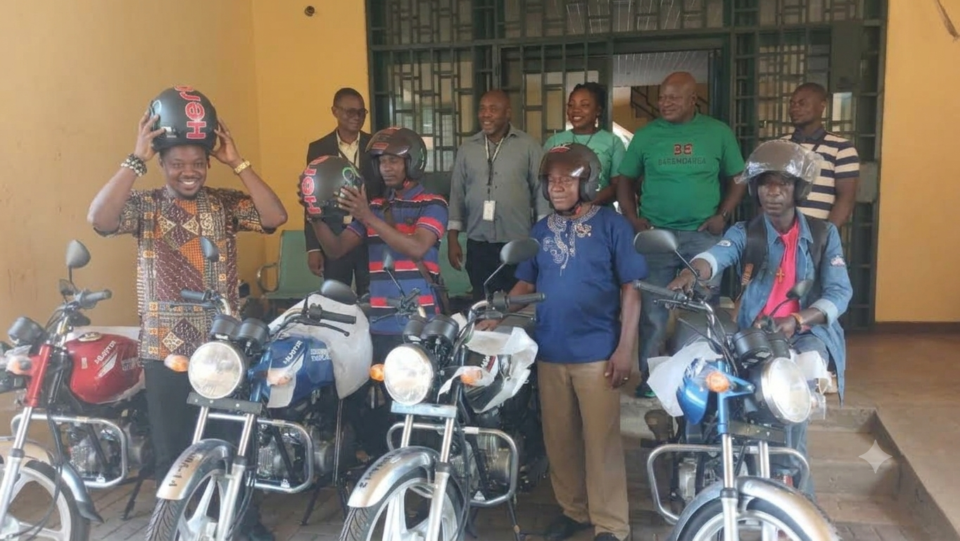
The second phase of the handover ceremony was held at the CNDRA headquarters in Sinkor, Monrovia, with seven county coordinators receiving motorbikes, official materials, and stationery supplies.
Among the counties represented were Lofa, River Gee, Grand Gedeh, and Maryland.
Speaking during the presentation, Emmanuel George Woodter, Special Assistant to the Director General of the National Archives, said the distribution of the motorbikes forms part of CNDRA’s broader decentralization policy aimed at extending archival services to all 15 counties.
Woodter, who presented the motorbikes on behalf of Director General Hon. D. Nelson Bearngar, said the concentration of most archival services in Montserrado County has created difficulties for citizens seeking basic government documents.
“This administration places premium on having archival services purely decentralized across the 15 counties,” Woodter said.
‘Why Travel From Maryland to Monrovia?’
Woodter questioned why citizens living in distant counties should be required to travel to Monrovia to obtain basic documents such as marriage certificates.
“Why would a couple wanting to get a simple marriage certificate travel from as far as Maryland to come here to access such a simple service?” he asked.
According to him, providing transportation to county coordinators will help bring CNDRA’s services closer to citizens while improving the Agency’s ability to operate effectively outside Montserrado County.
He said improved mobility would allow county personnel to travel to communities that are difficult to reach and provide services without requiring residents to make costly and time-consuming trips to the capital.
Beneficiaries Warned Against Misuse
Woodter also cautioned the beneficiaries against misusing or commercializing the motorbikes, stressing that mechanisms have been established to monitor their use.
He said the motorbikes are strictly intended to support CNDRA’s work in the respective counties and warned that beneficiaries could face administrative consequences if the government assets are misapplied.
He further urged the county coordinators to use the motorbikes responsibly for the growth and development of the National Archives.
Meanwhile, officials of the Agency emphasized that the motorbikes remain government assets and are not the personal property of the beneficiaries.
An official speaking during the ceremony said recipients would be required to sign an agreement outlining the terms and conditions governing the use of the motorbikes.
“These bikes are not to be commercialized,” the official cautioned, adding that misuse of government property could result in penalties.
The official said copies of the agreements would be kept by the Human Resources Office to ensure accountability and proper administrative oversight.
Outstation Department Welcomes Support
The presentation was subsequently turned over to Urias G. Kpakio, Outstation Manager, who received the ceremonial helmet on behalf of the county coordinators.
Kpakio thanked CNDRA management for supporting the outstation department, describing the distribution of the motorbikes as a long-awaited initiative that would improve the mobility of county coordinators.
He urged the beneficiaries to take management’s instructions seriously and ensure that the motorbikes are used responsibly.
“I urge all of the coordinators who are here, please, all that is said, please use these bikes wisely with a responsible conscience,” Kpakio said.
County Coordinators Pledge Responsible Use
Receiving the motorbikes on behalf of the county coordinators, one of the beneficiaries expressed appreciation to CNDRA management and the Government of Liberia for responding to their long-standing need for transportation support.
The coordinator said the motorbikes would make it easier for county staff to travel across their respective areas and provide services to citizens.
“Today, we are overjoyed. And we hope, as we receive these individual bikes, we’re going to use them for their intended purpose,” the coordinator said.
The beneficiary noted that the transportation support would be particularly important in counties with several districts and communities that require regular visits by government personnel.
The coordinator also pledged that the recipients would abide by the rules established by CNDRA for the use and management of the motorbikes.
Initiative Expected to Improve Rural Access
The distribution forms part of CNDRA’s ongoing efforts to decentralize its operations and improve access to archival and civil documentation services across Liberia.
Officials say improved mobility at the county level is expected to enhance service delivery, strengthen revenue-generating activities, and reduce the need for citizens in rural counties to travel to Monrovia to access basic archival services.
The initiative is therefore expected to bring government documentation services closer to communities while strengthening the National Archives’ presence and operations across Liberia’s 15 counties.
