


NATIONAL NEWS
MONROVIA – The Acting Chairman of the Governance Commission of Liberia, Alaric K. Tokpa, has underscored the critical role of the Financial Intelligence Agency of Liberia (FIA) in protecting the country’s financial system from corruption, illicit financial flows, and criminal exploitation.
By: Trokon S. Wrepue – trokon1992seokin@gmail.com
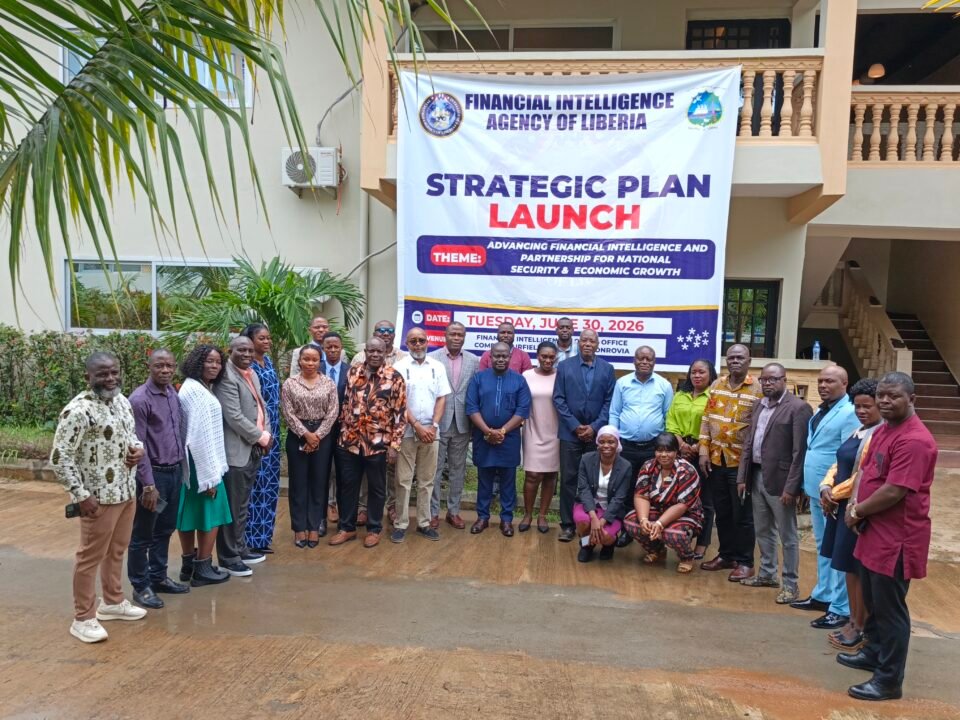
Speaking during the official launch of the Financial Intelligence Agency of Liberia’s Strategic Plan for 2026-2031 on Tuesday, June 30, 2026, Tokpa said the FIA is charged with the solemn duty of safeguarding Liberia’s financial system against waste and abuse and remains a central pillar within the country’s governance framework.
According to him, the FIA’s mission of protecting Liberia’s financial integrity contributes significantly to national, regional, and global peace and economic stability. He noted that the Agency embodies a vision of becoming a well-equipped institution dedicated to effective anti-money laundering and counter-terrorist financing efforts.
Tokpa stressed that by fulfilling its mandate, the FIA not only strengthens Liberia’s credibility but also ensures that governance remains transparent, accountable, and aligned with international standards.
“The FIA is not merely an institution of compliance but a guardian of integrity whose work directly advances Pillar Four, the Governance and Anti-Corruption Pillar of the ARREST Agenda for Inclusive Development,” he said.
He added that by monitoring financial flows, enforcing accountability, and aligning Liberia with international standards, the Agency ensures that the foundations of governance remain credible, transparent, and resilient.
Its mandate, he noted, is indispensable not only for safeguarding Liberia’s financial integrity but also for reinforcing public trust and affirming that state institutions serve the people with honesty and accountability.
Tokpa commended the leadership of FIA Director General Mohammed A. Nasser, saying the Agency is reclaiming its rightful place and performing its rightful role.
“The Governance Commission family and all Pillar Four institutions of the AAID join me to applaud the FIA, under the able leadership of Hon. Mohammed A. Nasser, for restoring the image of this noble institution,” he stated.
The Acting Chairman further lauded the Agency for commencing enforcement of sanctions against non-compliant institutions, issuing warnings to entities that violate regulations, and initiating investigations into irregularities across various sectors.
“These actions demonstrate that the agency is once again aligned with its founding mandate and purpose,” he said.
Tokpa also highlighted the importance of the FIA’s collaboration with regional and international bodies, including the Intergovernmental Action Group against Money Laundering in West Africa (GIABA), the Financial Action Task Force (FATF), and the Egmont Group of Financial Intelligence Units.
According to him, such partnerships are essential because most financial crimes, including money laundering, terrorist financing, and illicit financial flows, are transnational in nature and do not respect borders.
“Through these collaborative endeavors, the FIA gains access to intelligence-sharing networks, strengthens compliance with international standards, and ensures that Liberia is not isolated but remains part of a collective effort to safeguard financial integrity,” Tokpa said.
He described the launch of the Strategic Plan as more than a formality, calling it a covenant with the Liberian people that signals a commitment to transparency, accountability, and measurable progress.
By linking the FIA’s work to the government’s performance management contract, he noted, reforms will not only be promised but tracked, reported, and evaluated.
Tokpa said the country’s past experiences demonstrate the consequences of weakened institutions, while the progress being made today shows what is possible when integrity is restored and Liberia works closely with regional and international partners in the fight against corruption.
He stressed that the occasion was important not only for the FIA but also for Liberia as a whole because it speaks to the collective responsibility to protect the integrity of the financial system, strengthen public trust, advance national security, and support inclusive economic growth.
The Governance Commission Chairman explained that financial intelligence is central to governance because it helps identify illicit financial flows, money laundering, terrorist financing, corruption, fraud, and other activities that weaken institutions and deprive citizens of development opportunities.
“When criminal networks misuse the financial system, they do more than move money illegally. They undermine public revenue, distort markets, weaken legitimate businesses, threaten national security, and reduce confidence in the state. Therefore, protecting the financial system means protecting the Republic of Liberia,” he asserted.
Tokpa reiterated that the FIA’s mission is deeply aligned with Liberia’s national development priorities and with the Governance and Anti-Corruption Pillar of the ARREST Agenda, which is anchored in transparency and accountability.
As Chairperson of Pillar Four of the ARREST Agenda, he described the FIA’s work as a key component of Liberia’s governance reform architecture.
According to him, anti-corruption efforts cannot succeed through pronouncements and slogans alone but require evidence, strong institutions, proper coordination, professionalism, and the courage to follow facts wherever they lead.
He emphasized that financial intelligence enables government institutions to detect patterns, trace suspicious transactions, support investigations, and prevent the financial system from becoming a haven for illicit activities.
However, Tokpa cautioned that no single institution can perform this work alone. He stressed that the strength of financial intelligence depends on cooperation among the FIA, the Ministry of Justice, the Central Bank of Liberia, the Liberia Revenue Authority, law enforcement agencies, regulatory bodies, prosecutors, the judiciary, reporting entities, civil society, the media, and international partners.
He further called for timely information-sharing, coordinated action, joint training, clear procedures, mutual respect, and accountability for results among all institutions.
Tokpa also highlighted the important role of civil society in raising public awareness, demanding transparency, monitoring public integrity, and advocating for citizens affected by corruption and financial crimes.
He added that the private sector—including banks, insurance companies, real estate actors, money transfer institutions, lawyers, accountants, and other reporting entities—has a responsibility to protect the financial system.
“Compliance should not be treated as a burden. It should rather be seen as a contribution to responsible business and national stability,” he said.
The Acting Chairman explained that the Strategic Plan for 2026-2031 provides a roadmap aimed at enhancing financial intelligence effectiveness, strengthening interagency cooperation, deepening stakeholder engagement, and building institutional capacity.
While describing these priorities as appropriate, he cautioned that a strategic plan becomes successful only when it is effectively implemented, adequately resourced, monitored, reported on, and adjusted when necessary.
He also called for strengthening the legal, institutional, and technological tools needed to confront modern financial crimes, noting that criminals who abuse financial systems are becoming increasingly sophisticated.
Tokpa stressed that national security today extends beyond borders and weapons to include money, data, networks, and institutions.
“A country that cannot detect and disrupt the illicit flow of finance exposes itself to corruption, organized crime, terrorist financing, trafficking, and instability,” he warned.
He further observed that economic growth depends on financial integrity because investors seek predictable systems, citizens demand fairness, businesses require a level playing field, and development partners need assurance that resources are used appropriately.
Declaring that the launch represented a renewed national commitment, Tokpa said Liberia’s financial system must serve lawful enterprise, public development, and the welfare of citizens rather than criminal interests.
He urged government agencies to treat the Strategic Plan as a shared responsibility and called for greater national coordination and measurable results.
To the leadership and staff of the FIA, Tokpa commended their work as sensitive, complex, and often unseen but essential to Liberia’s economic growth and development.
He also called on civil society, the private sector, government institutions, and international partners to continue supporting Liberia’s reform efforts.
Expressing optimism, Tokpa said he hopes the Strategic Plan will become a living instrument for integrity, security, economic growth, and political stability and help build a nation where public institutions are trusted and public resources serve the public good.
He reaffirmed the Governance Commission’s commitment to collaborating with the FIA to advance a vision of Liberia where jobs, justice, and dignity become lived realities.
Also speaking during the program, FIA Deputy Director General Amos Y. Boakai said the Strategic Plan for 2026-2031 will significantly contribute to protecting Liberia’s financial system from financial crimes.
According to Boakai, the presence of Anti-Money Laundering and Countering the Financing of Terrorism (AML/CFT) competent authorities at the event reflected a shared commitment to protecting the integrity of Liberia’s financial system, strengthening good governance, and combating money laundering, terrorist financing, and other financial crimes.
“This Strategic Plan represents far more than an institutional roadmap. It is a national commitment to building stronger systems, fostering greater collaboration among stakeholders, and enhancing Liberia’s capacity to detect, prevent, and disrupt illicit financial flows,” Boakai stated.
He said the plan aligns with the Government’s ARREST Agenda for Inclusive Development and reinforces Liberia’s determination to promote transparency, accountability, and sound economic governance.
Boakai emphasized that the success of the five-year strategy would depend not only on the FIA but also on the collective efforts of government institutions, the private sector, civil society, international partners, and other stakeholders.
“We look forward to working together to build a resilient, compliant, and trusted financial system that safeguards Liberia’s economic future,” he said.
Meanwhile, FIA Technical Focal Person for Program and Planning, Micheal S. Doe, explained that the Strategic Plan was developed through an inclusive internal process based on a thorough analysis of the AML/CFT landscape, international standards established by the FATF, and the ARREST Agenda for Inclusive Development.
According to Doe, the launch was intended to formally introduce the document to government institutions, development partners, reporting entities, and civil society while mobilizing stakeholder support for its implementation.
He said the objectives of the event included officially unveiling the FIA’s strategic direction for 2026-2031, communicating the plan’s priorities and expected outcomes, and strengthening stakeholder awareness regarding the Agency’s future direction.
Former Director of the Financial Intelligence Unit of Liberia, now the Financial Intelligence Agency, Alex Cuffey, also underscored the importance of the Strategic Plan in strengthening Liberia’s public financial management and governance framework.
Cuffey said the plan is essential as Liberia works to mobilize domestic resources, attract investment, and achieve sustainable economic growth.
He stressed that an effective AML/CFT regime is fundamental to recovering, protecting, and redirecting public resources toward critical sectors such as education, health, infrastructure, energy, and agriculture.
According to him, the Ministry of Finance and Development Planning recognizes the FIA’s vital role in protecting the integrity of Liberia’s financial system and believes the successful implementation of the Strategic Plan will result in enhanced inter-agency cooperation, strengthened financial intelligence capabilities, improved support for asset recovery, and increased compliance with international standards and the FATF and GIABA mutual evaluation process.
The Ministry further noted that the prosecution of money laundering cases and the recovery of proceeds from financial crimes will be key outcomes of the Strategic Plan’s implementation and emphasized that adequate resources and political commitment are necessary for its success.
The Ministry reaffirmed its commitment to supporting the FIA in fulfilling its mandate.
Meanwhile, 35 participants, including members of the Inter-Ministerial Committee, competent authorities, and reporting entities, attended the launch ceremony at the FIA headquarters.
The five-year roadmap, officially launched on June 30, 2026, seeks to enhance financial intelligence effectiveness, strengthen interagency cooperation, deepen stakeholder engagement, and build institutional capacity.
The plan was developed through an inclusive internal process that drew on analysis of the AML/CFT landscape and international standards established by the Financial Action Task Force and the ARREST Agenda for Inclusive Development.
