


By: Sampson W Weah – sampsonwweah7@gmail.com
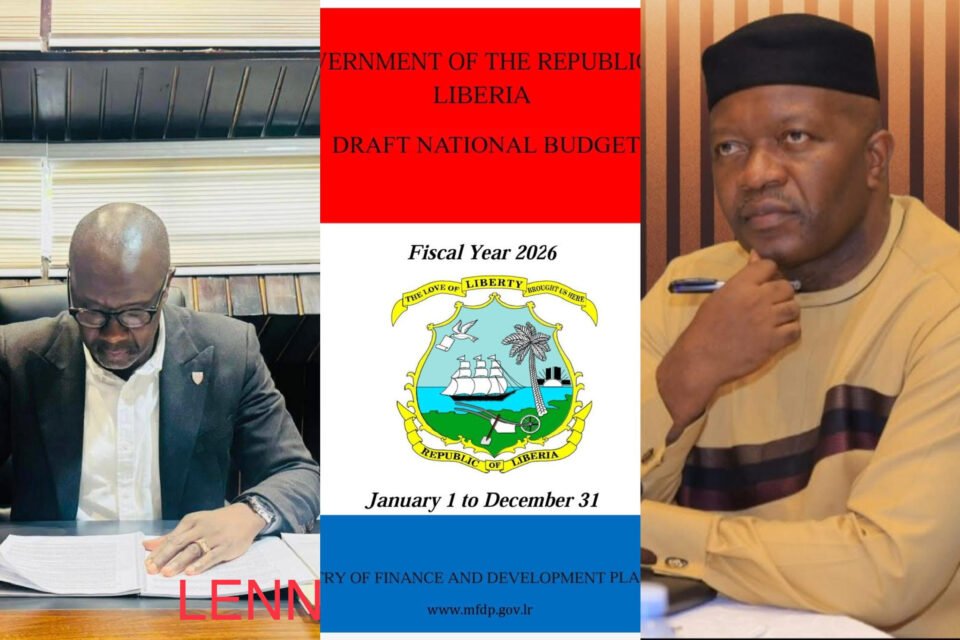
MONROVIA – Senator Amara M. Konneh has released a detailed analysis of the Draft FY2026 National Budget, praising the Boakai administration for presenting Liberia’s first-ever budget exceeding one billion dollars while cautioning that the document contains serious inconsistencies that threaten its impact and overall credibility.
In a national address on Tuesday, Senator Konneh commended President Joseph N. Boakai and Finance Minister Augustine K. Ngafuan for achieving a historic fiscal milestone.
He said the $1.2 billion draft budget signals Liberia’s expanding economic potential and shows growing confidence in the country’s financial management systems.
Despite the accomplishment, the former Finance Minister—now a leading member of the Senate Committee on Ways, Means, Finance, and Budget—warned that the draft budget does not properly align with the government’s own development priorities.
He pointed to a major disconnect between the budget and the ARREST Agenda for Inclusive Development (AAID). While the AAID identifies a funding need of $1.68 billion for priority sectors in FY2026, the draft budget allocates only $594 million, creating a shortfall of more than $1.08 billion.
Konneh described this as a clear example of misalignment between the nation’s ambitions and the resources committed to achieving them.
Konneh also expressed concern over the extent of donor dependency. Of the funding earmarked for AAID-related programs, more than half is expected to come from external partners, while the government’s contribution remains significantly lower.
He cautioned that this level of reliance undermines long-term ownership and sustainability. Still, he believes Liberia has the ability to meet its FY2025 expenditure target of $880 million and channel nearly $400 million of domestic resources into FY2026 priorities if revenues are managed more strategically.
The Senator highlighted worrying sectoral trends. He noted that Social Development Services is the only sector to experience negative growth, despite the country’s urgent social needs.
He observed that the education and health sectors, which grew by 8 percent and 10 percent respectively, are expanding at rates far below the overall national budget growth of 18 percent. Vulnerable groups, including persons with disabilities—who recently staged a protest near the Capitol—remain heavily underfunded.
According to Konneh, these issues contradict Liberia’s commitment to inclusive development.
Konneh’s analysis revealed further concerns about inequality in the health sector. The FY2026 allocation of $101.7 million translates to just $19.37 per person—an amount he said falls well below international benchmarks.
He also highlighted severe regional disparities. Counties such as Montserrado and Nimba receive more than six dollars per capita, while Gbarpolu, Grand Bassa, Sinoe, and Bomi receive less than a dollar and fifty cents per capita.
He warned that such imbalances pose a direct threat to equitable national progress and urged for more investment in preventive care, health infrastructure, and fair county-to-county allocations.
The education sector also faces serious challenges. While the budget increases to $132.9 million, its growth remains slower than the overall national budget.
Konneh noted that more than 60 percent of the sector’s funding goes to the University of Liberia and payroll obligations under Fiscal Affairs. Meanwhile, early childhood education receives only $20,000, and most rural counties receive less than $100,000 for basic and secondary education.
He criticized the sharp contrast with the Monrovia Consolidated School System, which climbs to $7.2 million, describing the situation as “centralization without equity” in a country where the majority of children live outside the capital.
Security spending, on the other hand, has surged. The draft budget allocates $151.8 million to the security and rule-of-law sector—a dramatic 38 percent increase from 2024. Konneh cautioned that although institutions such as the Judiciary, Ministry of Justice, and National Security Agency collectively receive more than $117 million, the social sectors continue to lag behind.
Senator Konneh argued that security gains must be matched by investments in health, education, and job creation. He warned that expanding enforcement without advancing human development is counterproductive.
The Senator also raised concerns about payroll transparency. Despite a rise in payroll expenditures by $13.4 million, there has been no documented increase in the number of civil servants. He described this as a red flag that requires urgent scrutiny.
The Ex-Finance Minister further noted that State-Owned Enterprises (SOEs) continue to appear in the budget as revenue contributors even though many do not consistently remit funds to the national treasury. He called for stricter enforcement of SOE obligations, improved governance, and the full integration of SOE-generated revenues into the national budget framework.
Konneh ended his analysis by emphasizing the need for unity and collective responsibility. He insisted that improving the FY2026 budget is a national imperative that transcends political affiliation. “It doesn’t matter which side of the political spectrum you are on.
The success of this budget determines the success of our country. We must get the FY2026 budget right—and I am confident we will,” he concluded.
